

Glenn Ligon: “Late at night, early in the morning, at noon”
The latest exhibition by Glenn Ligon, titled “Late at night, early in the morning, at noon,” opens this coming January at Hauser & Wirth New York and offers an immersive meditation on light, language, and the resonant power of the color blue. This two-part show deepens Ligon’s long-standing exploration of the space where text becomes atmosphere, and legibility dissolves into abstraction. Drawing inspiration from the words of James Baldwin and the emotive spectrum of Blues music, Ligon creates a visual experience that is at once intellectual and deeply felt.
Main points of the exhibition include a suite of new large-scale works on paper titled “Blue (for JB)”, presented in the gallery’s front space at 18th Street. These pieces evolve from the conceptual territory of his earlier Stranger paintings—works rooted in Baldwin’s essay “Stranger in the Village.” Beginning with rubbings made from original studies, Ligon manipulates Japanese Kozo paper to capture fragments of Baldwin’s prose. He then enlarges these impressions as silkscreens, layering them onto vivid blue backdrops and applying water to allow the ink to blur and drift. The result is a series of haunting, lyrical compositions that shift between text and texture, sensation and silence—where Baldwin’s words echo like notes in a slow-burning jazz improvisation.
Glenn Ligon’s Legacy of Printmaking and Cultural Dialogue
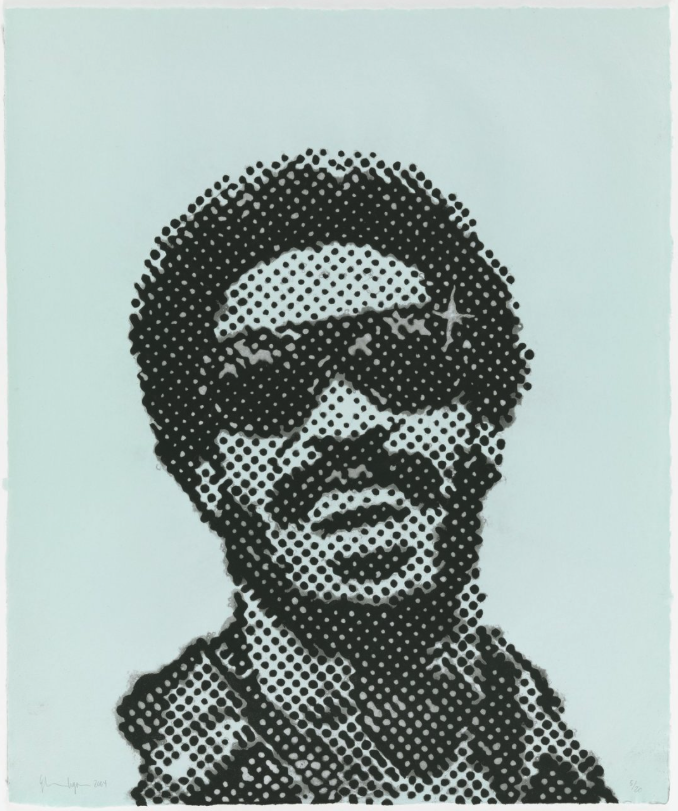
In the second gallery, visitors are treated to a retrospective sweep of Glenn Ligon’s printmaking oeuvre spanning the early 1990s through today. These historic works reinforce the thematic continuity in Ligon’s practice, rooted in Black identity, literary citation, and conceptual rigor. Among them is “Untitled (Four Etchings)” (1992), where Ligon references the voices of Zora Neale Hurston and Ralph Ellison, dissecting the American narrative with minimalist precision. The intimate “Self-Portrait at Nine Years Old” (2008) uses pulp painting and screen printing to reimagine the artist’s identity through childhood icons like Stevie Wonder and James Brown—an act of cultural interpolation that turns the personal into the political.
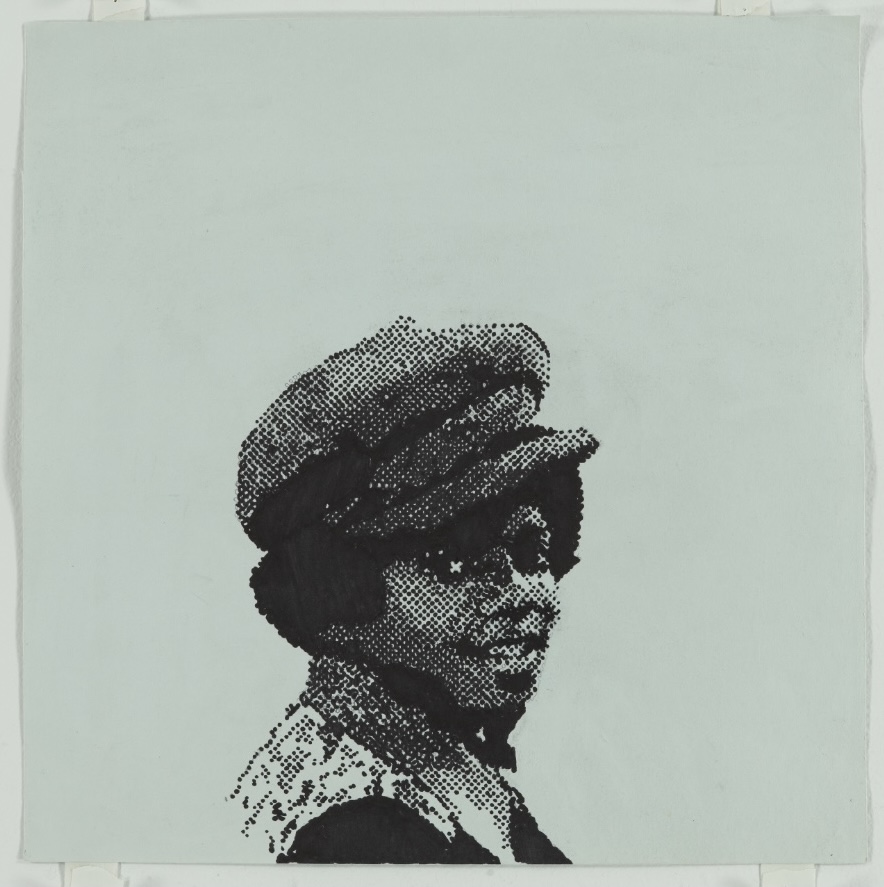
(left) “Self-Portrait at Seven Years Old” 2005, Ink and graphite on paper
(right) “Self-Portrait at Eleven Years Old” 2004, stenciled linen pulp on cotton-based sheet
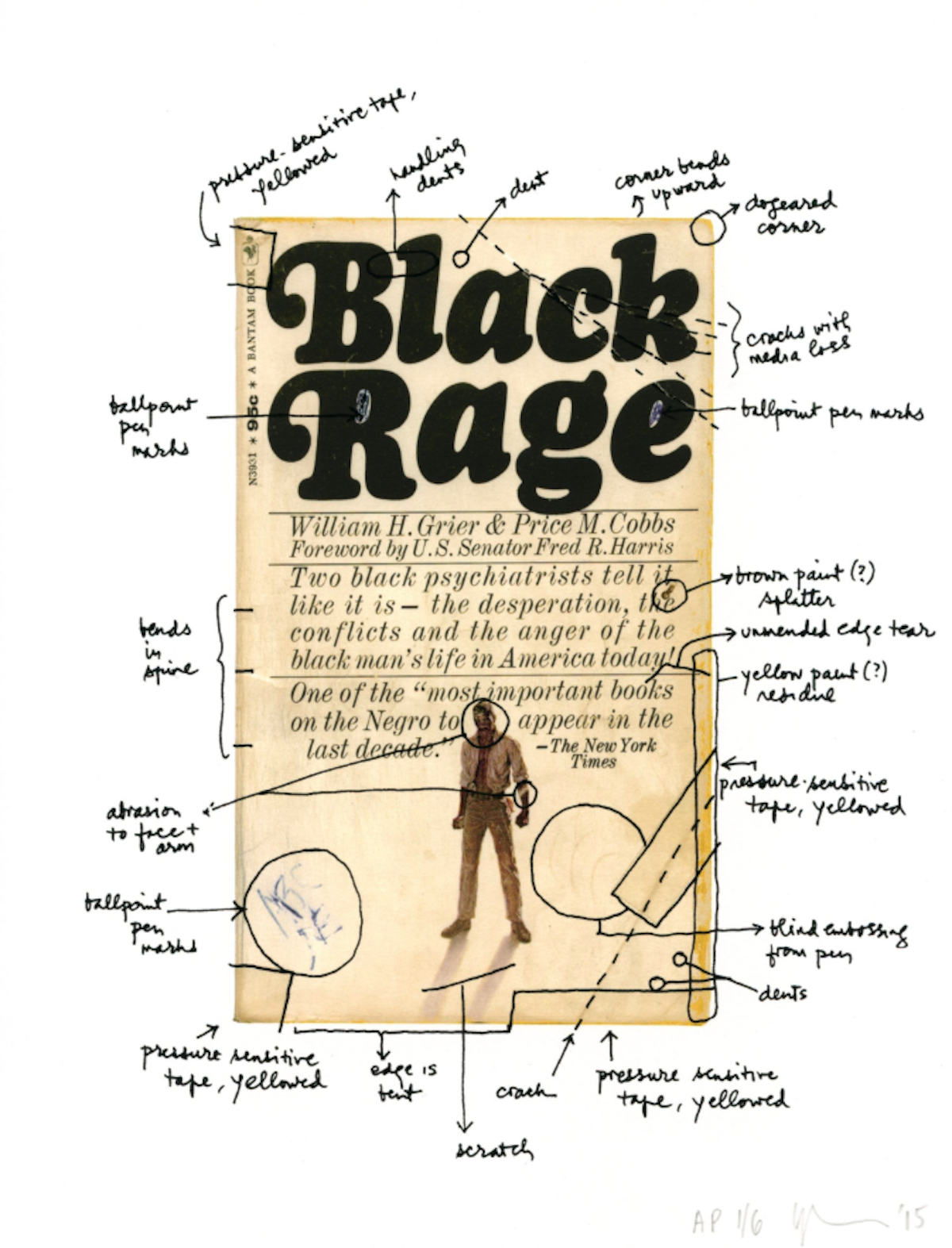
Also included is “Untitled (Condition Report for Black Rage)” (2015), a layered silkscreen and digital print that features a defaced cover of the 1968 book Black Rage. Its redactions and annotations speak volumes, as if each editorial mark exposes the fragility of Black expression within dominant historical narratives. Taken together, these pieces underscore Ligon’s deft ability to draw from collective memory while pushing the boundaries of artistic form.
What becomes clear throughout the exhibition is that Glenn Ligon’s engagement with printmaking is not a secondary pursuit but a core methodology. It is through this medium that he dissects meaning, challenges perception, and builds an intertextual dialogue between visual art and African-American literature. Ligon consistently wields abstraction as a form of resistance and revelation.
Glenn Ligon’s Blues: A Visual Language of Memory and Perception
The exhibition’s title, borrowed from Baldwin’s 1964 reflection on a Beauford Delaney painting, acts as a conceptual key. In it, Baldwin describes a late-afternoon light “as blue as the blues,” filtered through the branches of a tree. In Glenn Ligon’s hands, this poetic metaphor becomes a material strategy. The color blue here is more than a hue—it is mood, music, mourning, twilight. It represents everything just out of reach: the gap between image and word, past and present, clarity and obfuscation.
This idea is made manifest in “Blue (for JB)”, where text becomes a ghost of itself, submerged in watercolor washes, eroded by process, and softened by scale. These pieces invite viewers to move closer, to search for meaning beneath surface and sediment, and to consider how language—especially the language of Black thought and creativity—can be both elusive and essential.
Ultimately, “Late at night, early in the morning, at noon” reveals Glenn Ligon as an artist of immense subtlety and power. With this new work, he extends the legacy of Baldwin, Delaney, Hurston, Ellison, and others into the present moment, crafting an exhibition that is as visually seductive as it is intellectually profound. For those attuned to the shifting terrain of contemporary art and its intersections with race, literature, and cultural memory, this is a must-see event that affirms Ligon’s place as a central figure in the American artistic canon.
“Late at night, early in the morning, at noon” opens on January 16, 2026, and displays through March 14, 2026, at Hauser & Wirth New York.
Discover more from artsXhibit
Subscribe to get the latest posts sent to your email.