
Philip Guston and the Turn Toward the Personal
At Hauser & Wirth New York, “Life With P. Philip Guston: Paintings and Drawings 1964–1978” offers a revealing and deeply affecting perspective on one of the 20th century’s most formidable painters. On view from April 21 through July 2026 at the gallery’s 18th Street location, the exhibition focuses on a side of Philip Guston that is less publicly mythologized yet no less essential: the private artist, the husband, the observer of domestic ritual, and the draftsman who transformed ordinary life into a charged visual language. Best known for his raw painterly meditations on sociopolitical power and the darker contours of human nature, Guston here appears in a more intimate register, one shaped by marriage, family life, solitude, and emotional candor.
The significance of this presentation lies in its deliberate shift of emphasis. Rather than center only the monumental public force of Philip Guston as a major modern master, “Life With P.” illuminates the internal world that nourished his late figurative practice. The exhibition brings together intimate paintings and works on paper that ruminate on Guston’s life with poet Musa McKim, his wife and creative counterpart, particularly during their years in Woodstock. In doing so, it opens a rare window into the emotional and symbolic atmosphere of their shared life. The result is not simply an exhibition about biography, but a study of how love, routine, observation, and vulnerability become artistic material.
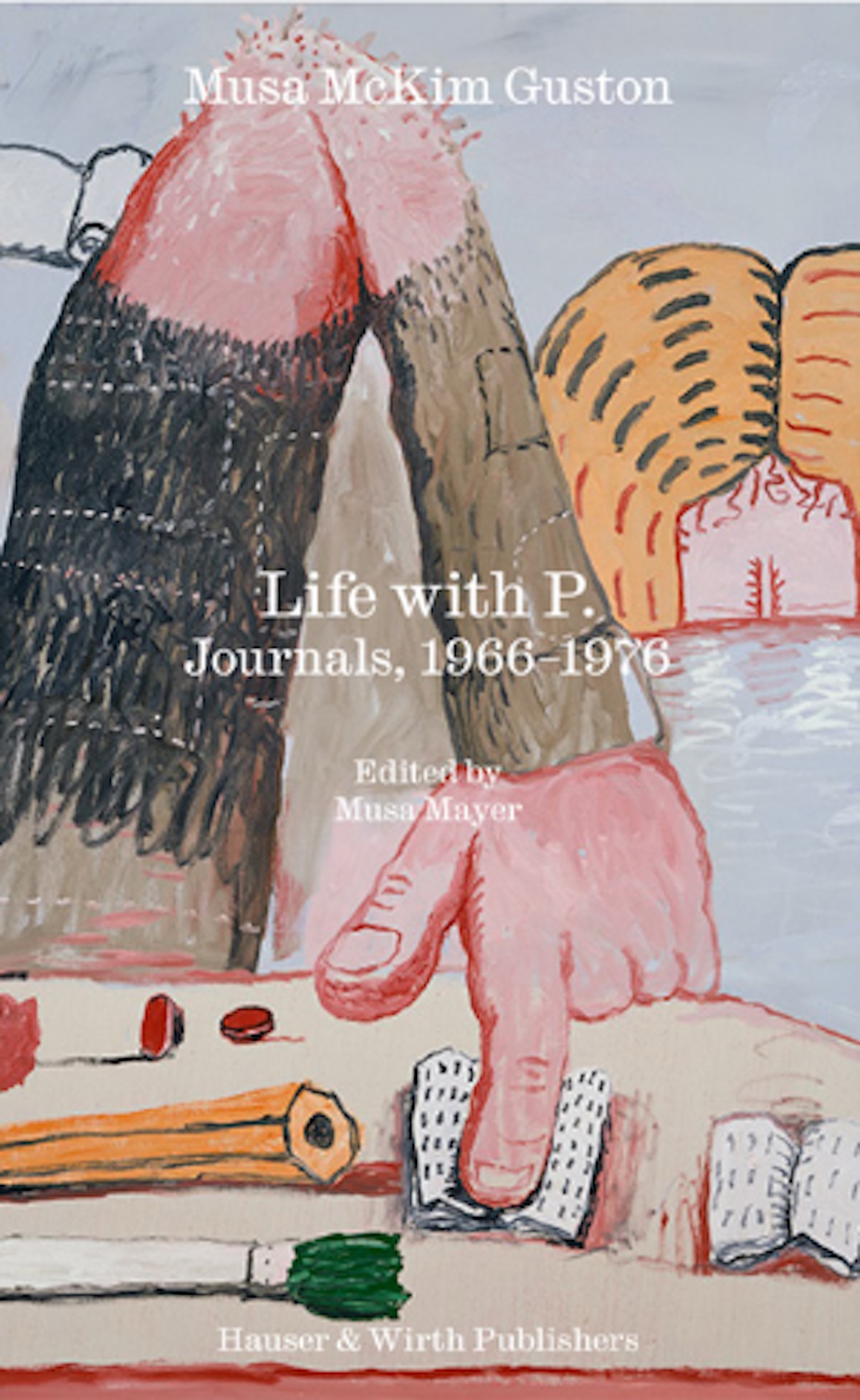
That deeper layer is amplified by the exhibition’s alignment with the release of a new Hauser & Wirth Publishers book of the same title. “Life with P.” gathers Musa McKim’s previously unpublished journals from 1966 to 1976, edited and contextualized by the couple’s daughter, Musa Mayer. Together, the exhibition and book create a richer portrait of the household and relationship that shaped so much of Guston’s later visual language. For viewers already familiar with the intensity and blunt force of Philip Guston, this presentation offers something rarer: an encounter with the intimate structures beneath the art.
Philip Guston, Musa McKim, and the Poetry of the Everyday
The backstory of this exhibition is inseparable from the artistic and emotional partnership between Guston and McKim. During the mid-1960s, Guston had turned intensely toward drawing, setting painting aside between 1966 and 1967 to explore what he called his “pure drawings.” These investigations into spare line and form became an important threshold in his development, stripping visual language down to essentials before his later figurative works reassembled the world in all its blunt, awkward, and moving materiality.
After Guston and McKim moved from New York City to Woodstock in 1967, their creative lives became increasingly attentive to the symbolic charge of the everyday. Rural seclusion sharpened perception. Household objects, books, furniture, bricks, license plates, kitchen surfaces, and small domestic signs became loaded with private meaning.
The ordinary, in Guston’s hands, never remains merely ordinary. It is transformed into a lexicon. What begins as quotidian observation gradually crystallizes into the emblematic imagery that undergirds his late figurative paintings. The domestic sphere became, for both Guston and McKim, a shared field of scrutiny and recognition.
“Blue Cover” 1977 Oil on canvas 80 x 102 x 1 1/4 in
McKim’s own writings animate this atmosphere beautifully. As she observed in 1969, she would notice the kitchen table, counters, and stove to see what “P.” had been doing, eating, or reading, and he did the same with her. It is a striking image of marriage not as sentimentality, but as sustained attention. In that sense, the exhibition’s title feels exact. “Life With P.” is not merely about living beside Philip Guston. It is about the reciprocal act of seeing and being seen.
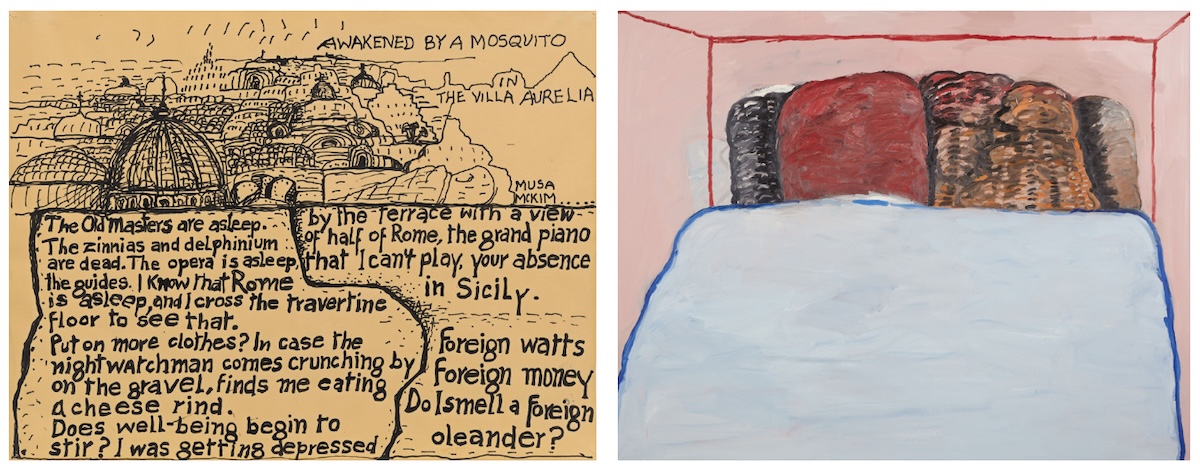
Among the most fascinating works in the exhibition are Guston’s “Poem Pictures,” drawings made in response to McKim’s poetry. These works suggest an artistic dialogue that moved fluidly between image and text, husband and wife, perception and reflection. Drawings such as “The Leaves Have Turned and Awakened by a Mosquito” from around 1972 to 1975 reveal how the sensibility of McKim’s writing entered Guston’s visual world. These are not grand declarations.
They are subtle acts of translation, where line becomes a way of listening. In an untitled drawing from 1975, Guston depicts the top of McKim’s head looming over an open book, distilling a moment of silent intimacy into something quietly profound. It is a scene of wordless understanding, and that may be the emotional center of the exhibition.
Philip Guston and the Emotional Iconography of Late Work
By the early 1970s, Guston’s art had become intensely autobiographical, and “Life With P.” makes that evolution unmistakably clear. Family was already present in earlier work, as seen in the abstract painting “The Three” from 1964, but the Woodstock years deepened the personal stakes of his imagery. The paintings and drawings from this period are rich with private iconography and emotional openness, portraying scenes of tenderness between Guston, McKim, and their child, while also confronting the anxieties that shadowed that intimacy: aging, mortality, desperation, and need. This is where Philip Guston becomes especially powerful, not only as a painter of form, but as a painter of exposed feeling.
Three large-scale figurative paintings, exhibited together for the first time and never before shown in a gallery or museum, anchor the emotional force of the presentation. In “Two Hearts” (1978), two wounded, limp hearts stand in symbolically for Guston and McKim, reducing marriage to an image at once tender, damaged, and unguardedly human.
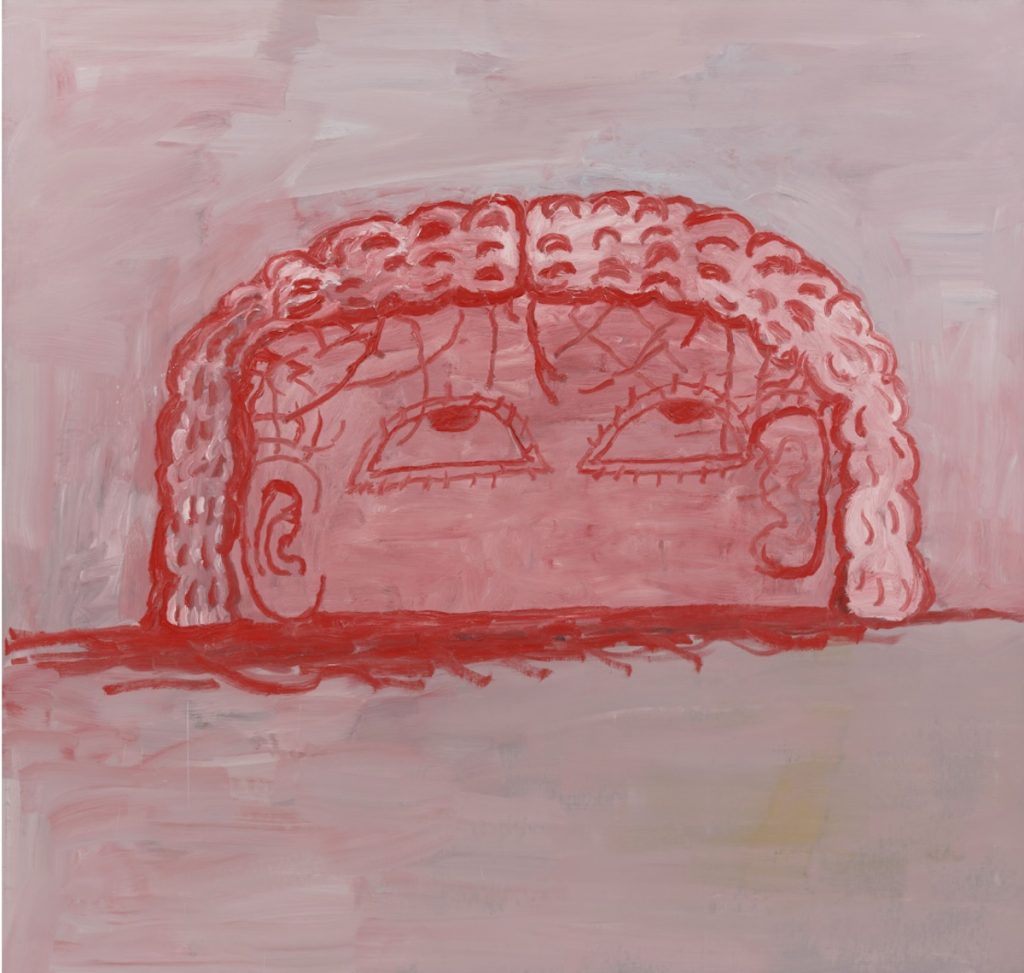
In “Blue Cover” (1977), the couple appears as block-like bodies joined within the confessional privacy of a shared bed, an image that feels simultaneously comic, vulnerable, and devastatingly real. In “Untitled” (1976), McKim is distilled into a near-caricature of curly hair and large contemplative eyes, a figure simplified but far from diminished. Across these works, Philip Guston does not sentimentalize love. He renders it as dependency, familiarity, fragility, and persistence.
His own words, reflecting on this period, give the exhibition its clearest key: “There is nothing to do now but paint my life; my dreams, surroundings, predicament, desperation, Musa—love, need.” That statement lands with particular force in this context because it reveals how fully Guston understood the stakes of his late work. He was no longer interested in distance or disguise. He was painting the immediacy of existence as he lived it.
That commitment is what makes the exhibition so resonant. It shows that the visual language of Philip Guston was not only built from public turmoil and historical consciousness, but from a deeply inhabited domestic life whose objects, gestures, and emotional textures became inseparable from the work itself.
At Hauser & Wirth New York, “Life With P.” works because it does not separate the artist from the life that fed the art. Instead, it reveals how the intimacy of home, the presence of a partner, the rhythms of reading and eating and watching, and the ache of mortality all shaped Guston’s late masterpieces. For seasoned admirers and newer audiences alike, this exhibition is a powerful reminder that great art is sometimes forged not only in confrontation with the world, but in the private negotiations of love, memory, and shared time.
You may also like
-
“No Other Place to Go”—5 Artists Turn Climate Data Into Human Experience at InLiquid Gallery
-
Erik Spehn Strips the Ground Away in “Waves Become Wings”
-
Zoya Cherkassky’s American Cooking Turns a Vintage Cookbook Into a Study of Displacement
-
“Shimmer—Dreaming the Posthuman” Argues That Care, Not Extinction, Is the Point
-
“New Now IX” at InLiquid Gallery