
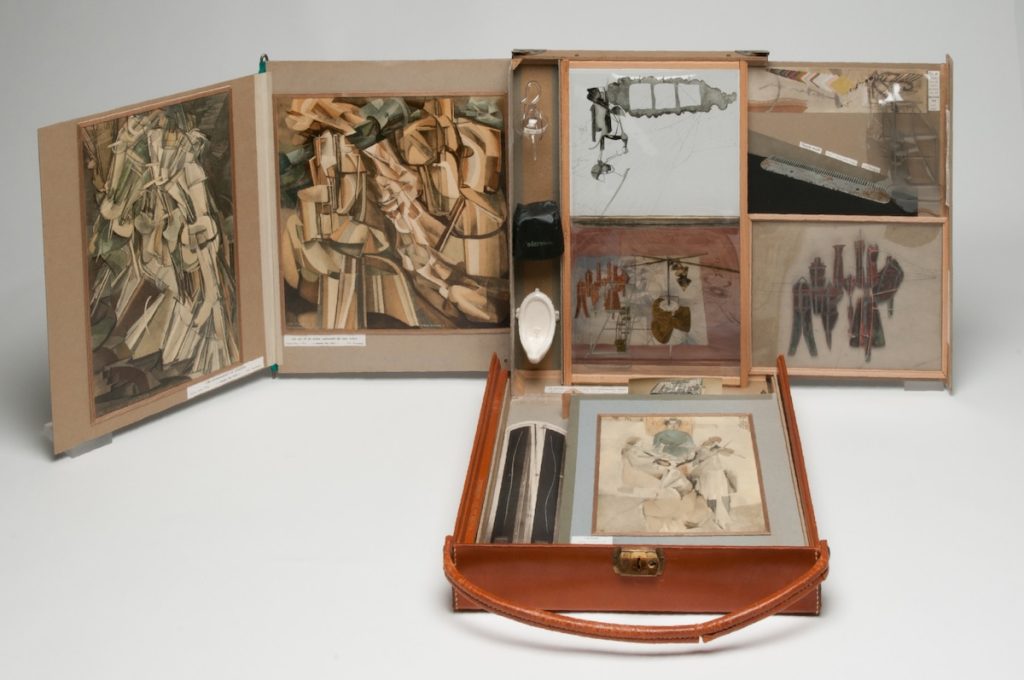
The Philadelphia Museum of Art is presenting the first major U.S. retrospective dedicated to Marcel Duchamp in more than half a century. Opening October 10, 2026, and running through January 31, 2027, the exhibition occupies the Dorrance Galleries and brings together approximately 300 works spanning the full arc of Duchamp’s career — from early drawings and paintings to sculptures, photography, film, and the readymades that permanently altered the course of art history. For anyone serious about modern and contemporary art, this Marcel Duchamp retrospective is the exhibition of the decade in Philadelphia.
The last comparable U.S. survey of Marcel Duchamp took place in 1973–74, co-organized by the PMA and The Museum of Modern Art in New York. Those same two institutions are behind this new retrospective, arriving more than 50 years later with the benefit of deep archival access and a fresh curatorial lens. The PMA holds the world’s largest Marcel Duchamp collection — approximately 200 paintings, sculptures, and works on paper, along with the most extensive archives relating to the artist’s life and work — making Philadelphia the natural center of gravity for a project of this scale.
Marcel Duchamp and the Making of Modern Art
To understand why a Marcel Duchamp retrospective carries this much weight, it helps to understand what Duchamp actually did. Associated at various points with Cubism, Dada, and Surrealism, he never fully belonged to any of them. His practice was one of constant reinvention, driven less by style than by questioning — questioning what art was, what an artist did, and what a museum was supposed to be.
The retrospective opens with Duchamp’s early years: his work as a cartoonist for the satirical press, his apprenticeship in the styles of French modernism, and his emergence as a member of the Cubist group in Paris in 1911 and 1912. The pivot point came quickly. When Duchamp submitted Nude Descending a Staircase (No. 2) (1912) to his fellow Cubists, they rejected it as too radical. Its display at the 1913 Armory Show in New York caused a scandal — and made Duchamp’s reputation as a provocateur practically overnight.
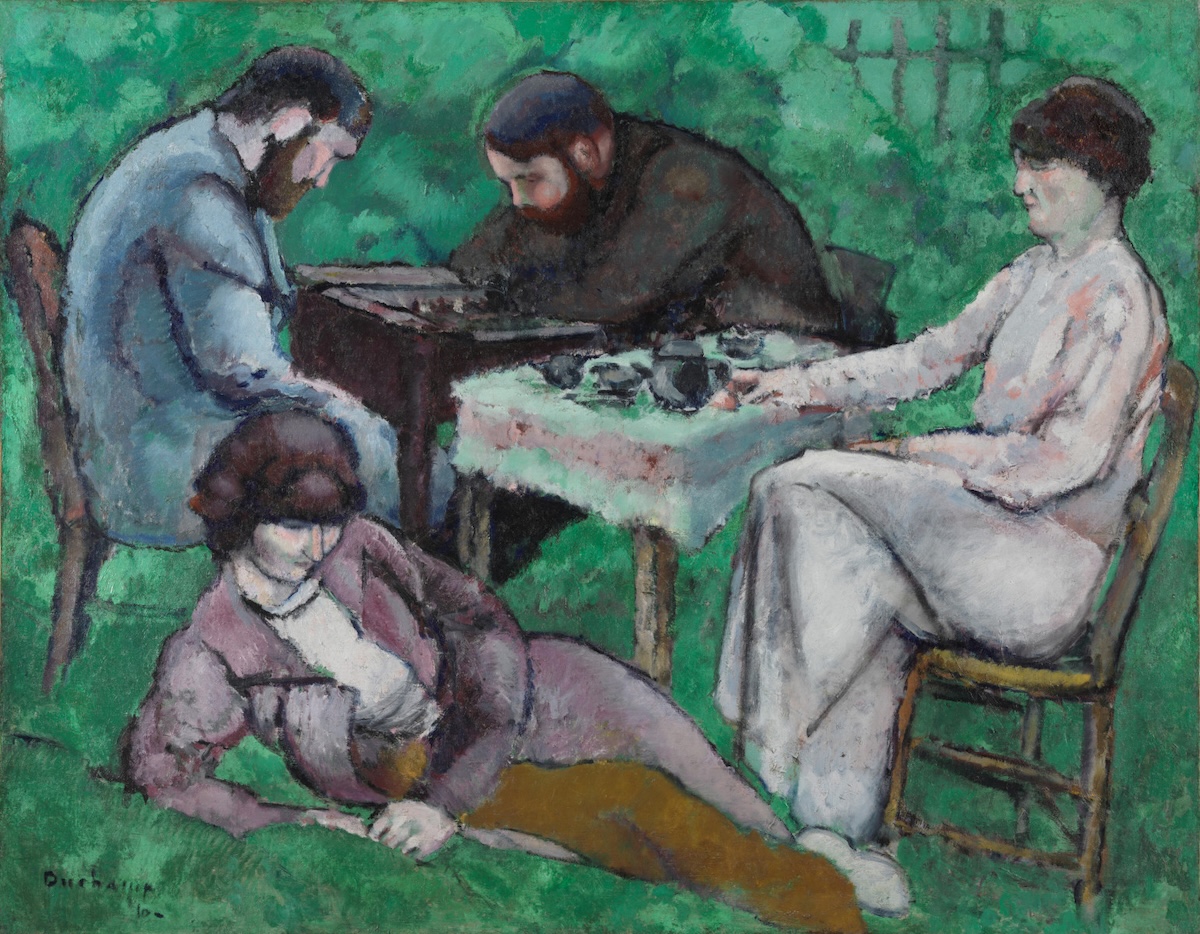
The Marcel Duchamp Readymades and The Large Glass
The retrospective gives sustained attention to Marcel Duchamp’s readymades — the works that arguably did more to shape 20th-century art than anything else produced in that century. When Duchamp designated a commercially manufactured bicycle wheel, a bottle rack, or a porcelain urinal as works of art, he didn’t just challenge the art world — he restructured the entire philosophical framework through which objects, authorship, and aesthetic value are understood.
The exhibition traces the invention of the readymades through surviving early examples including With Hidden Noise (1916), Apolinère Enameled (1916–17), and L.H.O.O.Q. (1919), his irreverent defacement of a reproduction of the Mona Lisa with a moustache, beard, and a phonetic pun. A comprehensive group of readymade replicas — including iterations of Bicycle Wheel (1913), Bottle Rack (1914), In Advance of the Broken Arm (1915), and the notorious Fountain (1917) — will also be on view.
Running alongside the readymades is the story of The Bride Stripped Bare by Her Bachelors, Even (The Large Glass) (1915–23), the monumental work on glass that Duchamp spent nearly a decade planning and executing with extraordinary precision. One dedicated section of the exhibition examines the full range of materials and preparatory approaches behind this masterpiece, offering a rare window into his exacting process. The Large Glass itself remains on permanent display at the PMA, and visitors will be invited beyond the Dorrance Galleries to see it — along with Étant donnés — in Galleries 281–283.
Rrose Sélavy, Box in a Valise, and the Late Work of Marcel Duchamp
The retrospective follows Marcel Duchamp through several more remarkable transformations. Around 1920, he adopted the female alter ego Rrose Sélavy and began working in two new directions: language games — aphorisms, puns, tongue twisters, and spoonerisms — and optical machines producing visual illusions with no material reality. Both veins pushed his practice further from conventional art-making and deeper into conceptual territory.
By the mid-1930s, Duchamp turned his attention to his own legacy, producing the work known as Box in a Valise (1935–41): a portable museum of miniature reproductions of his drawings, paintings, works on glass, and readymades. The PMA’s presentation of Box in a Valise will be the most extensive to date, featuring three deluxe examples, a complete set of standard copies assembled between 1941 and 1971, and a large, never-before-seen selection of preparatory materials. It is one of the most conceptually rich objects in all of modern art — a work about art, reproduction, and legacy folded into a suitcase.
The exhibition closes with the work Duchamp created in secret during the final two decades of his life, when most assumed his artistic output had ended. Étant donnés (1946–66) is a room-sized diorama — visible only through two peepholes in a wooden door — featuring a sculpted female figure in a landscape. Installed at the PMA in 1969 according to Duchamp’s own instructions, it stands as the conceptual alter ego of The Large Glass and one of the most quietly astonishing works in the museum’s permanent collection.
Marcel Duchamp: Curators, Catalogue, and Global Tour
Marcel Duchamp is organized by Matthew Affron, the Muriel and Philip Berman Curator of Modern Art at the PMA, alongside Ann Temkin, the Marie-Josée and Henry Kravis Chief Curator of Painting and Sculpture at MoMA, and Michelle Kuo, Chief Curator at Large and Publisher at MoMA. The exhibition is accompanied by an illustrated catalogue published by MoMA, authored by the co-curators, covering Duchamp’s museum-like approach to private collections, his role in founding the Société Anonyme, Inc., his relationship with MoMA, and his decision to make the PMA the permanent home of his work.
The Philadelphia presentation follows the exhibition’s debut at MoMA (April 12–August 22, 2026), and precedes a related presentation at the Grand Palais in Paris in Spring 2027. For a full picture of what the PMA has planned across its 2026–2027 season, see our earlier coverage of the Philadelphia Art Museum 2026 Exhibition Season.
Plan Your Visit to See Marcel Duchamp at the PMA
Marcel Duchamp is on view at the Philadelphia Museum of Art from October 10, 2026 through January 31, 2027. The Dorrance Galleries are located at 2600 Benjamin Franklin Parkway, Philadelphia, PA 19130. Visitors are encouraged to allow additional time to visit Galleries 281–283, where The Large Glass and Étant donnés are on permanent display. Admission details and tickets are available at philamuseum.org.
You may also like
-
“No Other Place to Go”—5 Artists Turn Climate Data Into Human Experience at InLiquid Gallery
-
Erik Spehn Strips the Ground Away in “Waves Become Wings”
-
Zoya Cherkassky’s American Cooking Turns a Vintage Cookbook Into a Study of Displacement
-
“Shimmer—Dreaming the Posthuman” Argues That Care, Not Extinction, Is the Point
-
“New Now IX” at InLiquid Gallery