
Carol Rama spent seven decades making art that polite society tried to look away from — and now, a decade after her death, the looking has reversed. Hauser & Wirth‘s first exhibition dedicated to the Italian artist, “I See You You See Me,” gathers six decades of painting, sculpture, textile, and bricolage into a show organized by Carlo Knoell that refuses to sort Carol Rama into neat periods. Instead, it traces the continuity underneath — the focused experimentation and cultural foresight that made her work feel prophetic to audiences who were not yet born when it was first censored.
Carol Rama from Figuration to Abstraction
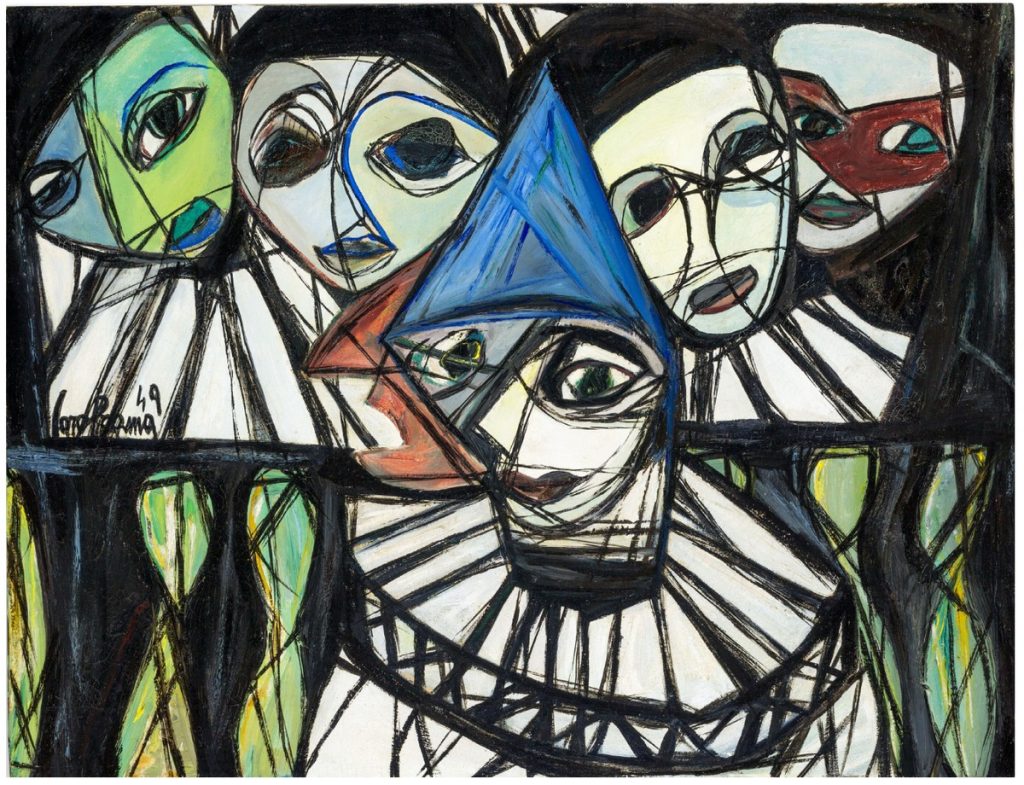
The earliest work on view, Dorina (Appassionata) from 1943, is a small watercolor that already contains everything Carol Rama would spend the next half-century chasing — the body, desire, agency, and the refusal to separate any of them from each other. By 1949, Pagliacci (Clowns) introduces a grid structure beneath the painted clowns whose eyes hold the viewer with a deliberate, almost sentient intensity.
That painting does two things at once: it points backward toward the figuration Carol Rama was leaving and forward toward the abstraction she was about to enter when she joined the Movimento Arte Concreta in 1951. MAC offered structure — geometric forms, mathematical principles, rational non-representation — but Rama’s work assumed a more dynamic and irregular character almost immediately, and by 1960 she had walked away from the group entirely.
Bricolage, Doll’s Eyes, and the Gaze of Carol Rama
The exhibition’s center of gravity is the bricolage work that followed. Carol Rama began introducing everyday objects — wires, metal shavings, syringes — into the pictorial plane, rejecting consumerism and the artistic status quo by demanding a sensorial rather than logical reading of the work. Many of these pieces incorporate three-dimensional doll’s eyes, extending a motif of sight that runs through the entire show. The eyes are taxidermic and unnerving.
They return the viewer’s gaze, collapsing the one-way dynamic of looking and asserting a bodily presence that most painting avoids. That motif carries into the Napalm Pictures of 1968 and 1969 — spray-painted figures on monochrome grounds that evoke burned, tormented bodies while sustaining Carol Rama’s entanglement of corporeality and eros in the shadow of the Vietnam War.
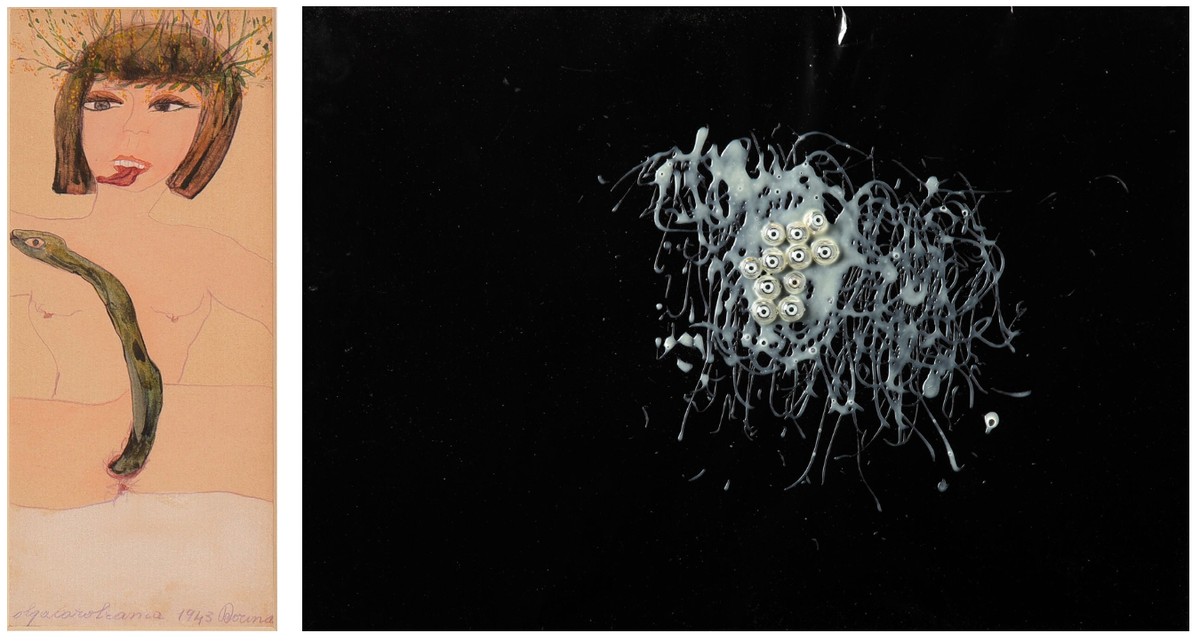
(right) “Untitled” 1968. Glue and doll’s eyes on glossy black cardstock. 19 5/8 x 27 1/2 inches.
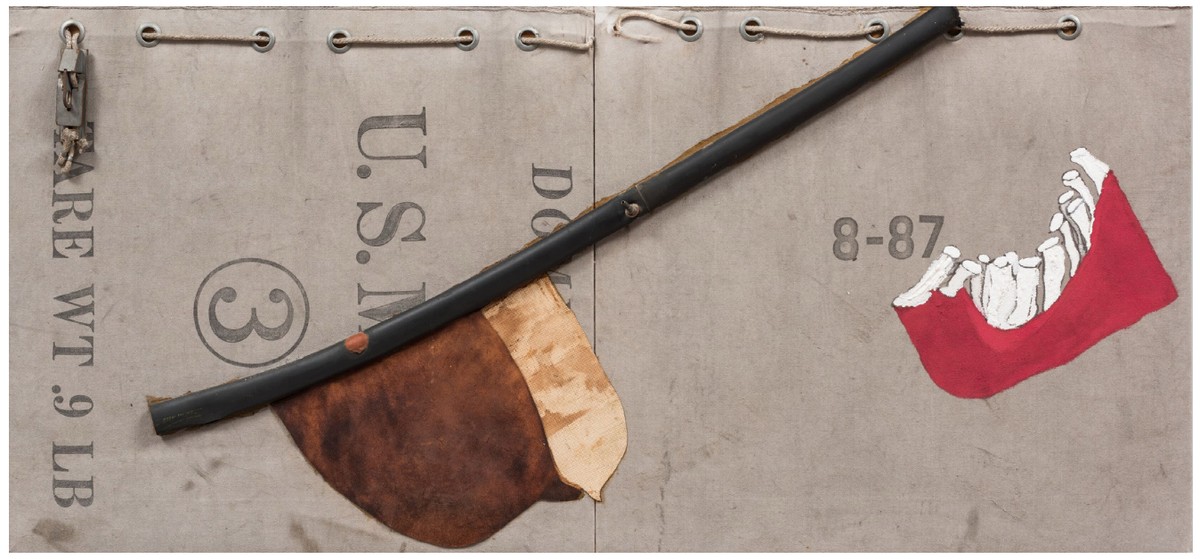
Found objects extended beyond the canvas. Car inner tubes became a recurring material, appearing in the wall relief La guerra è astratta (War Is Abstract) from 1970 and in Presagi di Birnam (Omens of Birnam) from 1986, one of the only sculptures Carol Rama ever made. The relationship between unconventional materials and political meaning remains one of the most charged conversations in contemporary art, and Rama’s inner-tube works were among the earliest to make that connection explicit — rubber that once held air pressure repurposed to hold the weight of war.
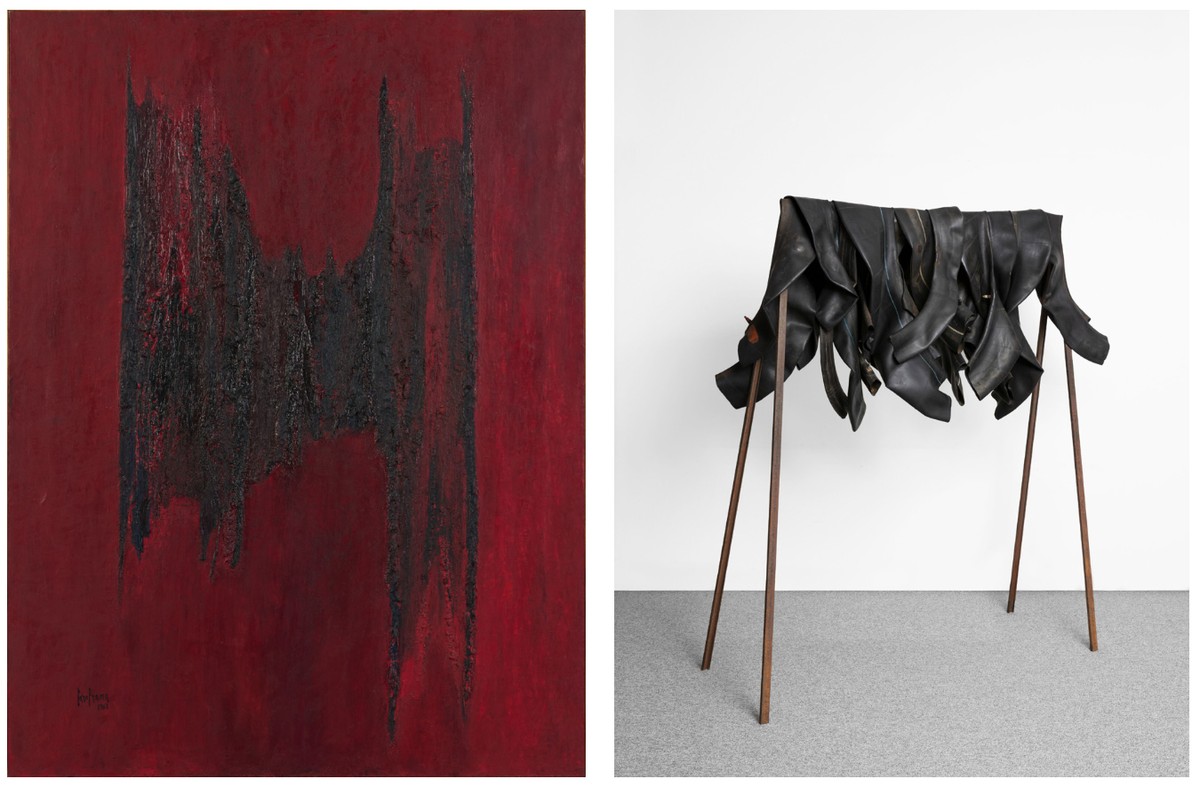
(right) “Presagi di Birnam (Omens of Birnam)” 1986. Car inner tubes on metal easel. 70 7/8 x 51 5/8 x 23 5/8 inches.
The Mad Cow Series and the Legacy of Carol Rama
The most recent works belong to the Mad Cow series from the 1990s, inspired by the first European BSE outbreak and its unsettling collapse of boundaries between animal and human. Carol Rama described these deconstructed bovine anatomies as self-portraits — a claim that sounds like provocation until you spend time with the work and realize she meant it.
The series encapsulates the spirit of the entire career: cyclical yet progressive, persistent yet radically open to transformation. Rama once said that her rebellion consists of painting, and that self-assurance exists only across from a sheet of paper that needs to be filled in. Work was the only way to drive off her fears. “I See You You See Me” is on view at Hauser & Wirth, New York.
You may also like
-
“No Other Place to Go”—5 Artists Turn Climate Data Into Human Experience at InLiquid Gallery
-
Erik Spehn Strips the Ground Away in “Waves Become Wings”
-
Zoya Cherkassky’s American Cooking Turns a Vintage Cookbook Into a Study of Displacement
-
“Shimmer—Dreaming the Posthuman” Argues That Care, Not Extinction, Is the Point
-
“New Now IX” at InLiquid Gallery