
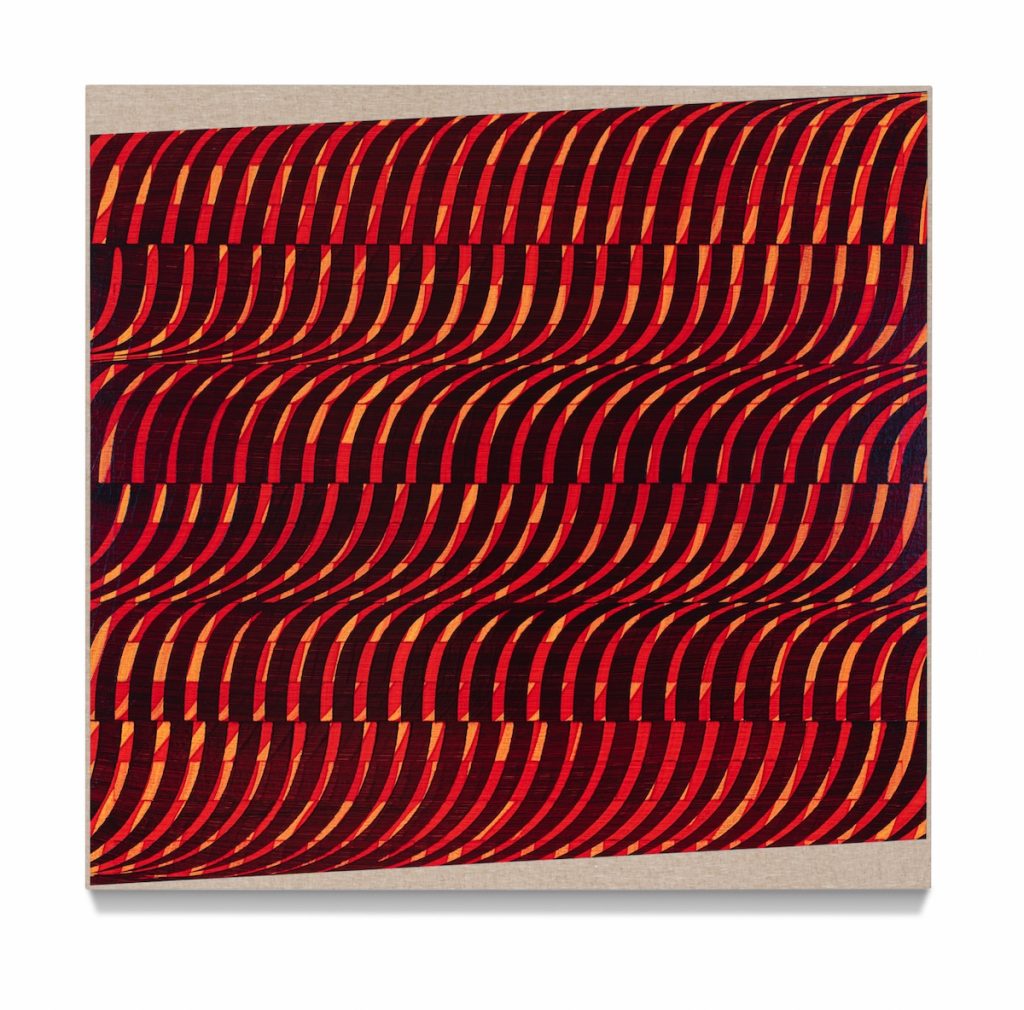
Erik Spehn has spent his career refining a distinct visual language built from hard edges and dense, undulating color, and in “Waves Become Wings”, opening September 8 at Pentimenti Gallery, he’s pushed that language further by removing something fundamental: the painted ground itself. The show runs through October 24, with an opening reception September 10 from 6 to 8 PM.
Erik Spehn Abandons the Painted Ground
In these new works, Spehn has left the natural linen exposed rather than painting the ground beneath his compositions, as he has in past bodies of work. That undifferentiated space functions as a deliberate pause — a passive interlude from the gestural activity elsewhere on the canvas, meant to slow a viewer down at the exact boundary where figure meets ground.
It’s a subtraction that changes how the whole composition reads. Spehn’s line work remains organized into woven vertical and horizontal bands across the picture plane, but with raw linen doing some of the visual work now, the paint itself has to earn its presence rather than filling every available inch of the surface.
Erik Spehn’s Apollonian Order Against Dionysian Chaos
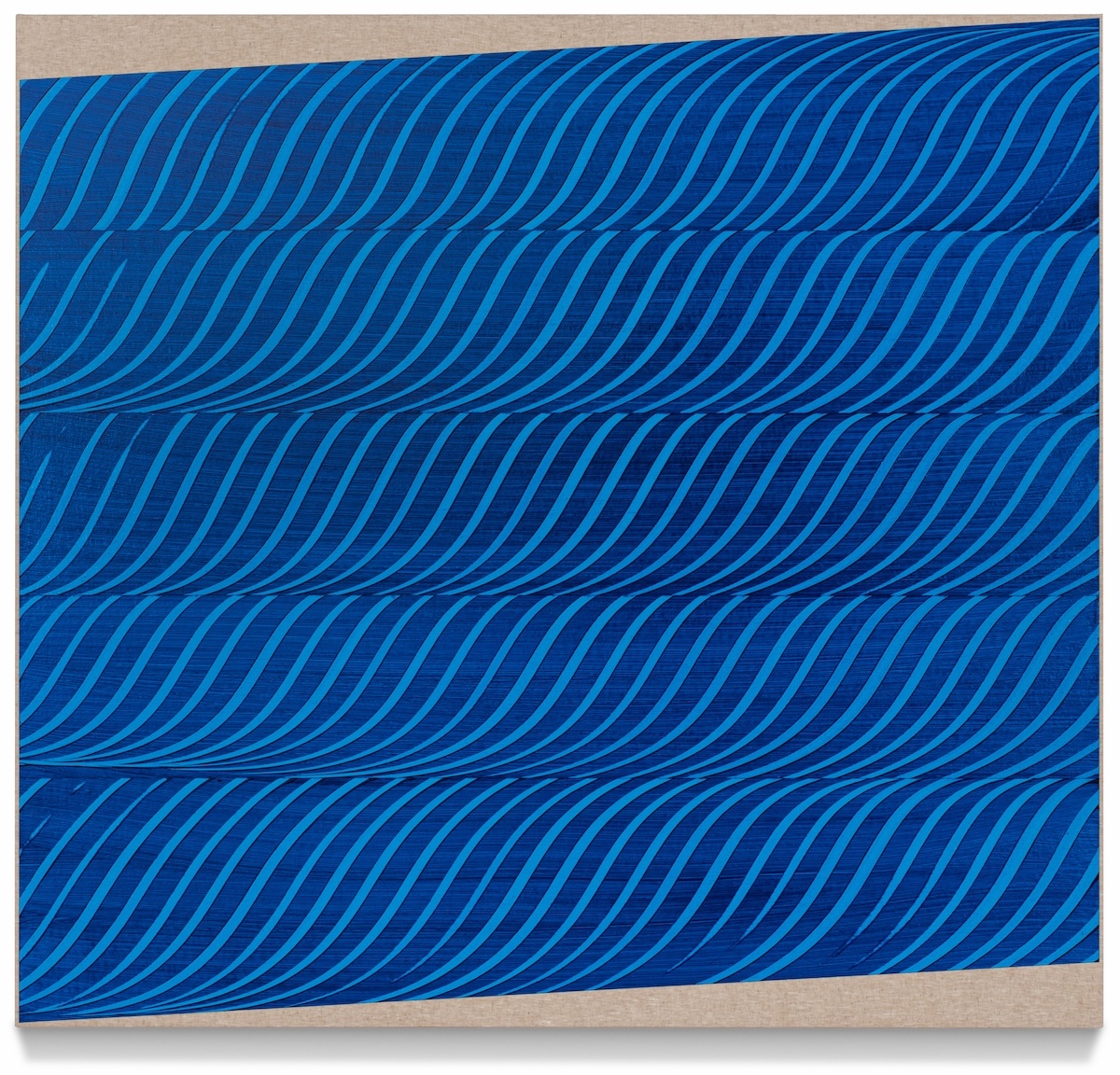
Spehn frames this body of work through a specific philosophical lens: the concept of principium individuationis, the principle of individuation, and its dissolution. In practice, that means rigid, Apollonian systems of order set directly against Dionysian gestural mark-making — an acknowledgment that paint is inherently mercurial and chaotic, and that the grid-like architecture Spehn builds exists specifically to constrain it.
That tension is the real engine behind the work rather than a curatorial afterthought. The grid Spehn works from is loose enough to allow real variation, and the “algorithmic possibilities” his woven bands generate read less like a fixed system than a live negotiation between control and accident, repeated across every canvas in the show.
The Doppelgänger Panels
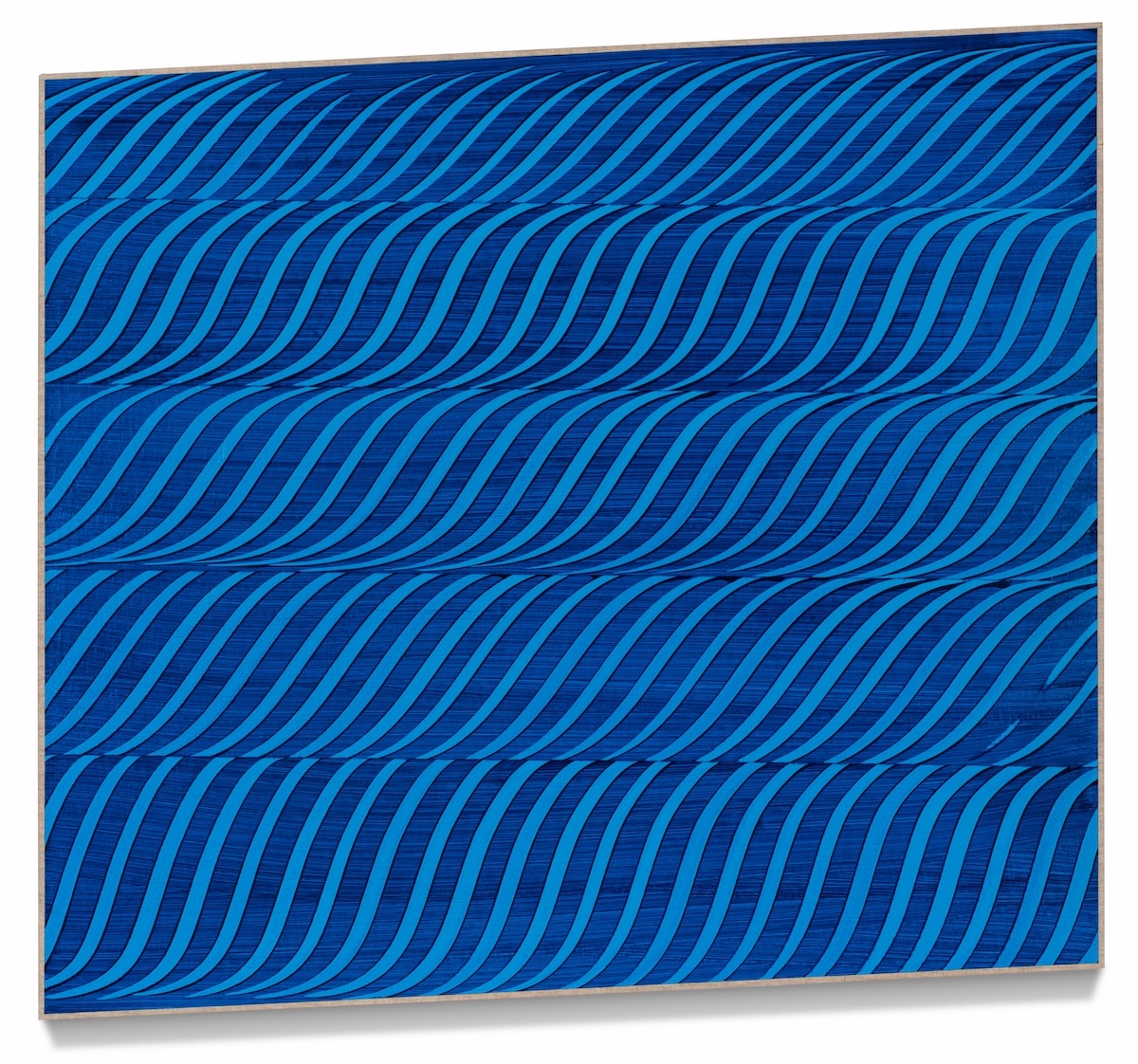
A parallel investigation runs alongside the main body of work: shaped panels presented side-by-side with rectangular counterparts, matched in proportion and palette. Spehn is explicit that these pairs engage questions of simulacra — authenticity, replication, and illusion, staged as literal doubles hanging next to each other in the gallery.
The pairing forces a genuinely uncomfortable question for a viewer: if two works share proportion, palette, and formal logic, but differ only in the shape of their support, which one is the “real” painting, and does that distinction mean anything at all? Spehn doesn’t resolve it, which is precisely the point.
A Career-Long Inquiry Still Evolving
Spehn earned his BFA from the University of Michigan School of Art and has exhibited at the Albright-Knox Art Gallery, the Contemporary Art Museum St. Louis, the Daum Museum of Contemporary Art, and internationally at Saarländisches Künstlerhaus in Germany and Centre d’art Contemporain in Metz, France. His work sits in collections including the Saint Louis Art Museum, Albright-Knox, and Temple University here in Philadelphia.
“Waves Become Wings” arrives at Pentimenti, a gallery with a track record of platforming exactly this kind of formally rigorous, conceptually dense abstraction.
What makes this particular Erik Spehn show worth real attention isn’t just the technical shift of the exposed linen or the philosophical scaffolding Spehn cites — it’s the open question both leave behind. If individuation dissolves under close enough inspection, and a copy can sit convincingly beside its original, what’s actually left to call authentic in a painting built this deliberately from contradiction?
You may also like
-
Made Over Time Puts Two Half-Century Painting Practices in One Room
-
“No Other Place to Go”—5 Artists Turn Climate Data Into Human Experience at InLiquid Gallery
-
Zoya Cherkassky’s American Cooking Turns a Vintage Cookbook Into a Study of Displacement
-
“Shimmer—Dreaming the Posthuman” Argues That Care, Not Extinction, Is the Point
-
“New Now IX” at InLiquid Gallery