
Zoya Cherkassky opens American Cooking at Fort Gansevoort on September 16, her fifth exhibition with the gallery and a body of work built directly out of her own displacement — a Ukrainian-born artist who immigrated to Israel as a teenager, then left Israel after the October 7 attacks in 2023 and settled in Long Island.
The paintings and drawings on view run through November 7, and they read less like documentation of a new country than an attempt to translate one.
The Immigrant’s Eye Behind Zoya Cherkassky’s American Cooking
The show’s title comes from a vintage cookbook Cherkassky found near her Long Island studio, its stilted food photography and unfamiliar recipes catching what she’s described as her own “foreigner’s eye.” She began making small watercolors from its images, treating the exercise as “an exercise in learning a new language” — a way of decoding an unfamiliar cultural vocabulary one image at a time, rather than a straightforward homage to the source material.
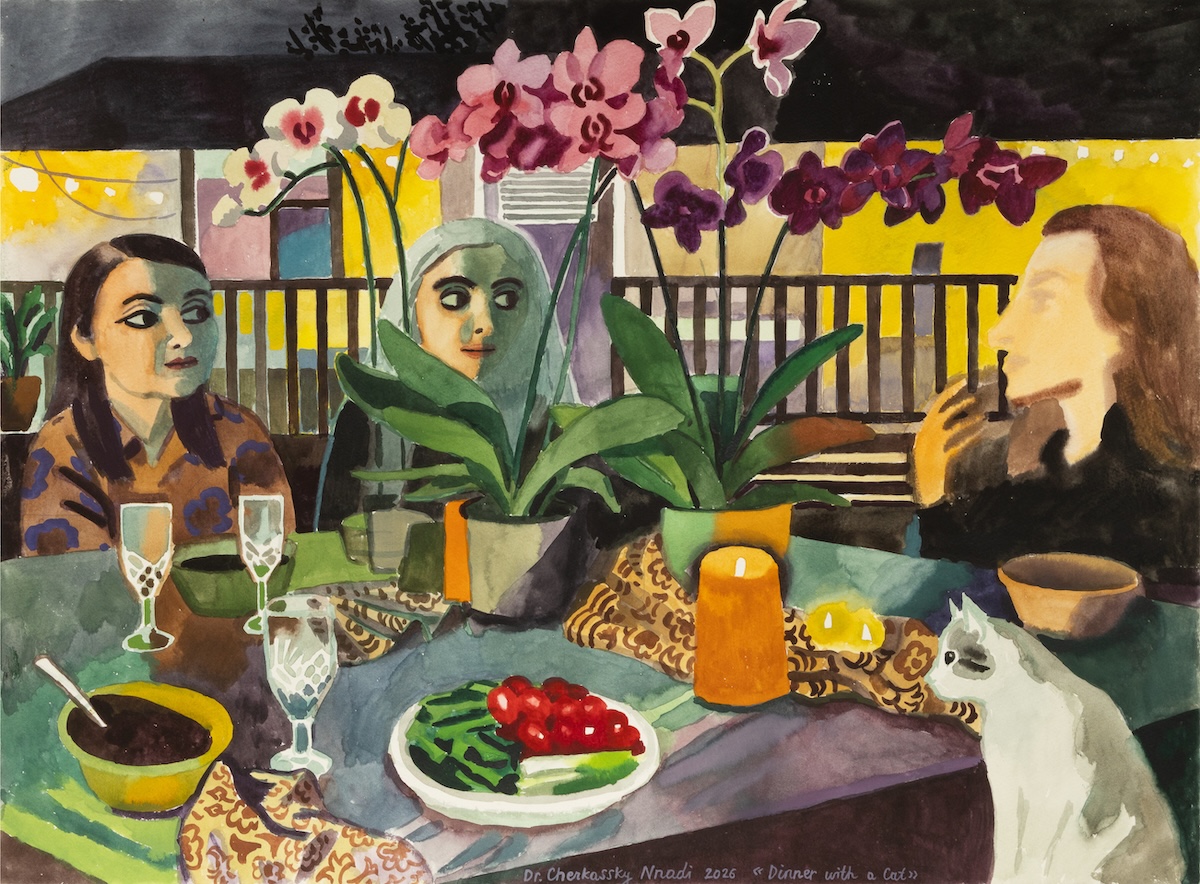
Food recurs throughout American Cooking, but it functions more as an entry point than a subject in itself. Cherkassky moves from delicatessens and markets to playgrounds, subway cars, and sidewalk scenes, treating each as a clue toward what she has called the “nerve of America” — a search that pulls as much from observed daily life as from the history of American painting itself.
Three Paintings That Carry the Show’s Real Weight
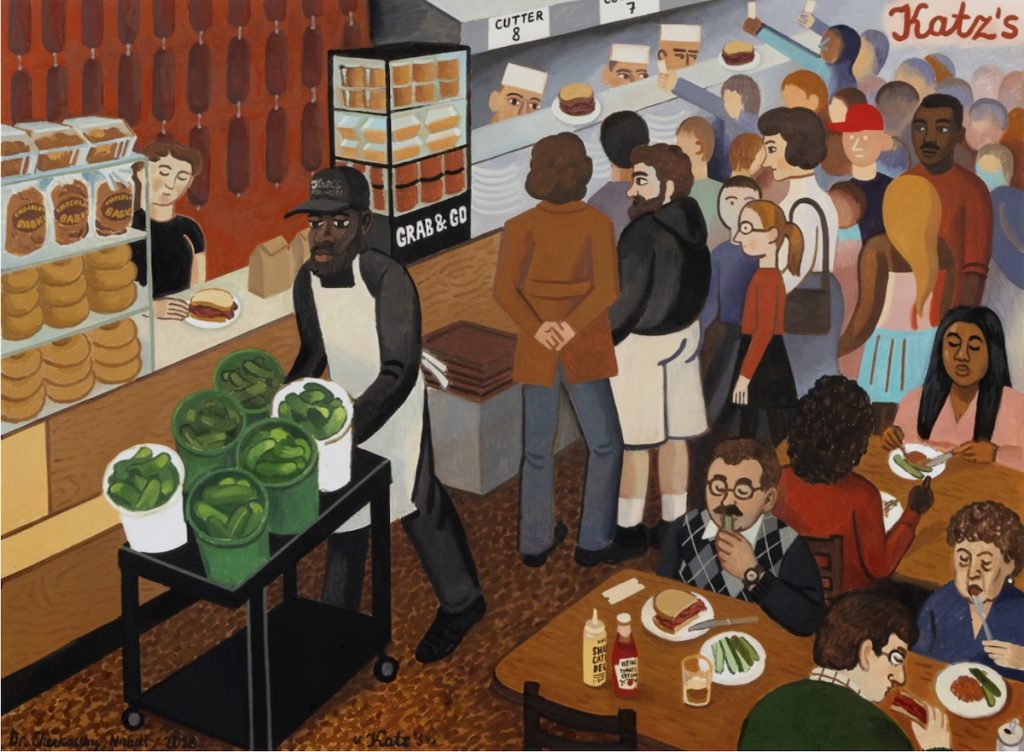
Katz’s (2026) captures the famous downtown Manhattan delicatessen through a crowd queuing at the counter, but the composition’s real subject is a worker pushing a cart of pickles toward the kitchen — labor that hums in public view while going largely unnoticed.
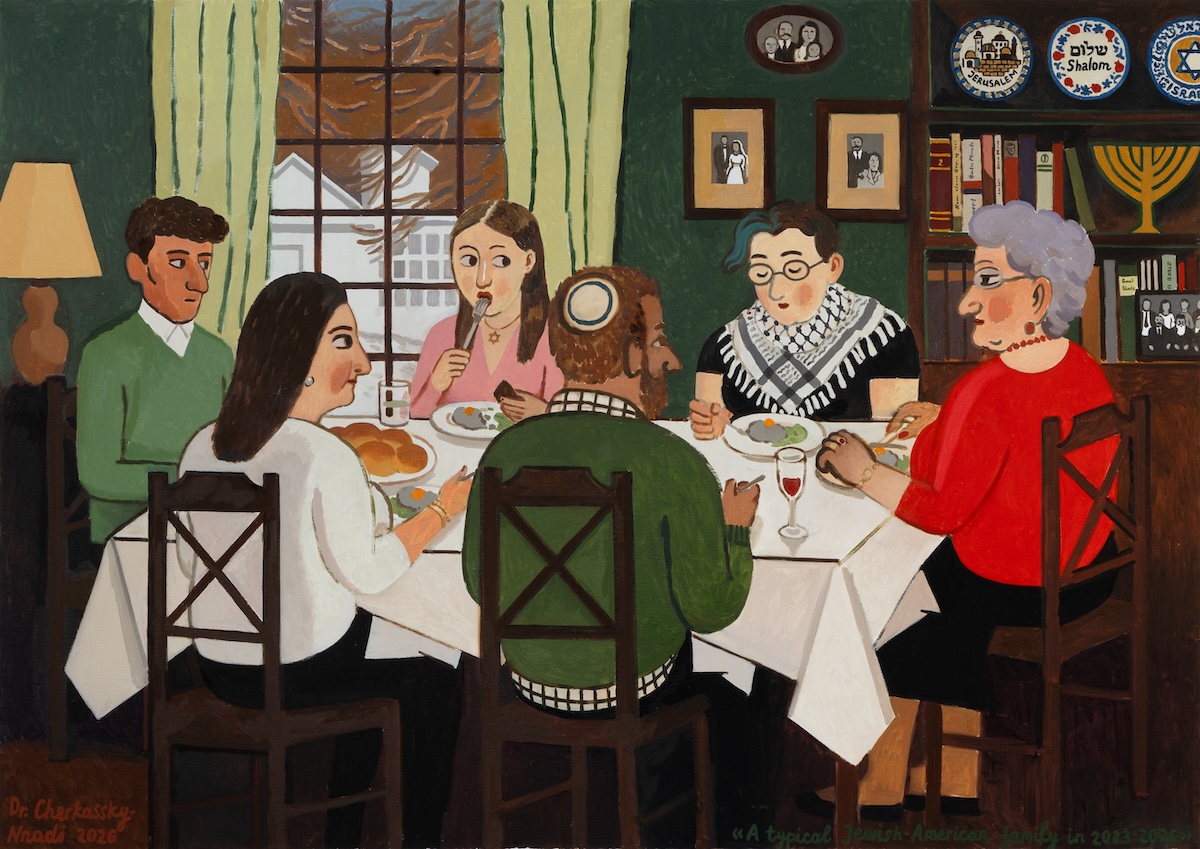
A Family at the Table (2026) takes the opposite register entirely: a private Shabbos dinner scene where one young woman at the table wears a keffiyeh alongside relatives in yarmulkes and Star of David jewelry, locating the Israel-Palestine conflict inside the warmth of a suburban dining room rather than at a remove from it.
The most direct art-historical statement is The New American Gothic (2026), a double portrait of Cherkassky and her Nigerian husband posed in homage to Grant Wood’s 1930 painting. Where Wood’s Midwestern farmer holds a pitchfork, Cherkassky’s husband holds a menorah instead — a small substitution that reframes an image originally meant to reassure Depression-era America into a statement about how unfixed “Americanness” actually is.
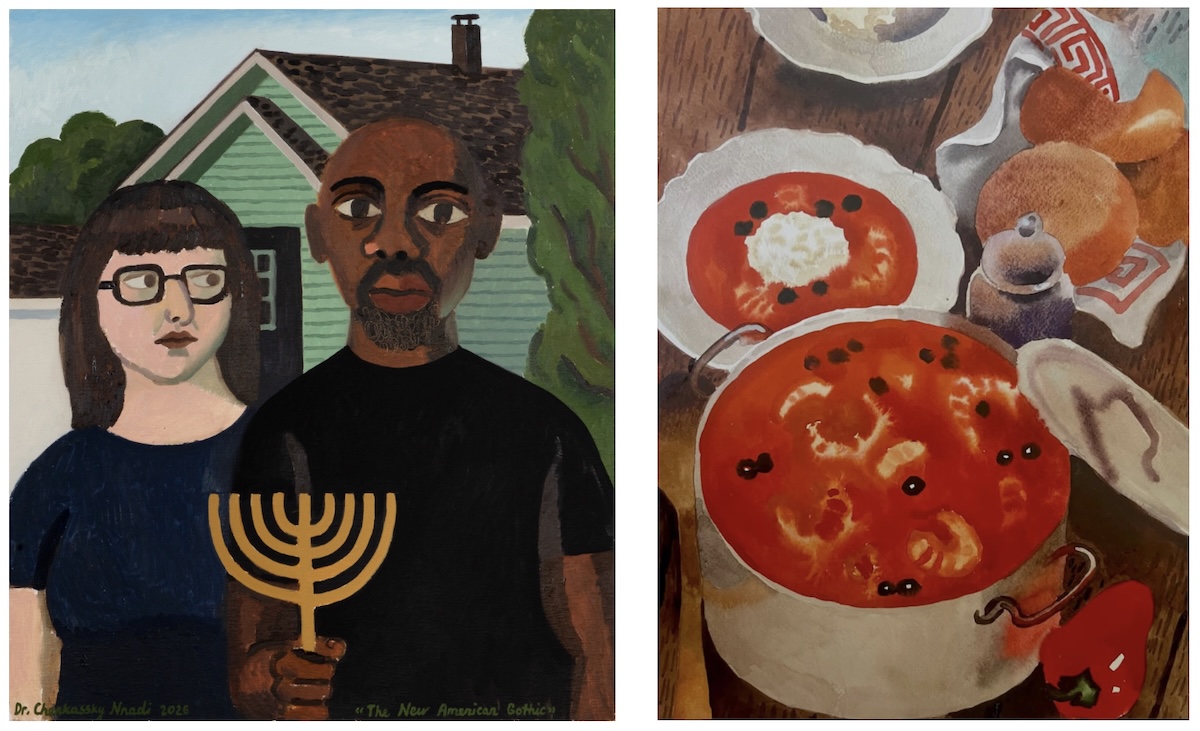
right: “Shrimp-Oyster Gumbo” 2026. Watercolor on paper. 13 x 9.5 inches.
Zoya Cherkassky’s Place in Contemporary Figurative Painting
Critic Roger Malbert, writing in the 2023 survey Drawing in the Present Tense, described Cherkassky’s perspective as “more subtle, complicated and penetrating than straight reportage or social commentary” — a process of thinking through the act of drawing itself rather than illustrating conclusions already reached. That description holds across American Cooking, where even the lightest, most quickly rendered works carry the same interpretive weight as the fully finished paintings.
Cherkassky’s career has moved through the Jewish Museum in New York, the Israel Museum in Jerusalem, and the Tel Aviv Museum of Art, with her 2023-24 solo show ‘7 October 2023’ at the Jewish Museum marking a direct predecessor to this current body of work.
Placed alongside other contemporary figurative painters currently reexamining American identity, Cherkassky’s outsider vantage point — arriving late, and by necessity rather than choice — gives American Cooking a specific kind of clarity that comes only from having to learn a place rather than simply inheriting it.
You may also like
-
“No Other Place to Go”—5 Artists Turn Climate Data Into Human Experience at InLiquid Gallery
-
Erik Spehn Strips the Ground Away in “Waves Become Wings”
-
“Shimmer—Dreaming the Posthuman” Argues That Care, Not Extinction, Is the Point
-
“New Now IX” at InLiquid Gallery
-
Universal Nature—Rebecca Rutstein at the Berman Museum