
Shimmer—Dreaming the Posthuman opens at the Frist Art Museum in Nashville on September 25, and its title invites a misreading the exhibition itself works hard to correct. This isn’t a show about human extinction or a world after people — it’s an argument, made through 17 artists working across analog and emergent technologies, that the posthuman is an ethical position rather than a hypothetical timeline.
What “Posthuman” Actually Means in Shimmer—Dreaming the Posthuman
Frist Chief Curator Mark Scala, who organized the exhibition, frames posthumanism as a rejoinder to human exceptionalism — the assumption that humanity’s outsized power over the natural world comes without obligation. “Although humans do have an outsized ability to control our environment, we have not always understood that this brings with it an ethical charge for care,” Scala writes. The title itself carries a double reference: to the wavering, transformative “shimmer” from Alex Garland’s 2018 film Annihilation, and to anthropologist Deborah Bird Rose’s use of the same word to describe Australian Aboriginal sand paintings that lead into the Dreamtime, where relationships between species are fluid rather than fixed.
That dual reference sets the tone for the whole show — art that borrows the visual language of transformation and metamorphosis to make an argument about interconnectedness, using tools like CGI, augmented and virtual reality, motion capture, and generative software alongside older physical media like deer hide and glass.
The Three Sections Structuring Shimmer—Dreaming the Posthuman
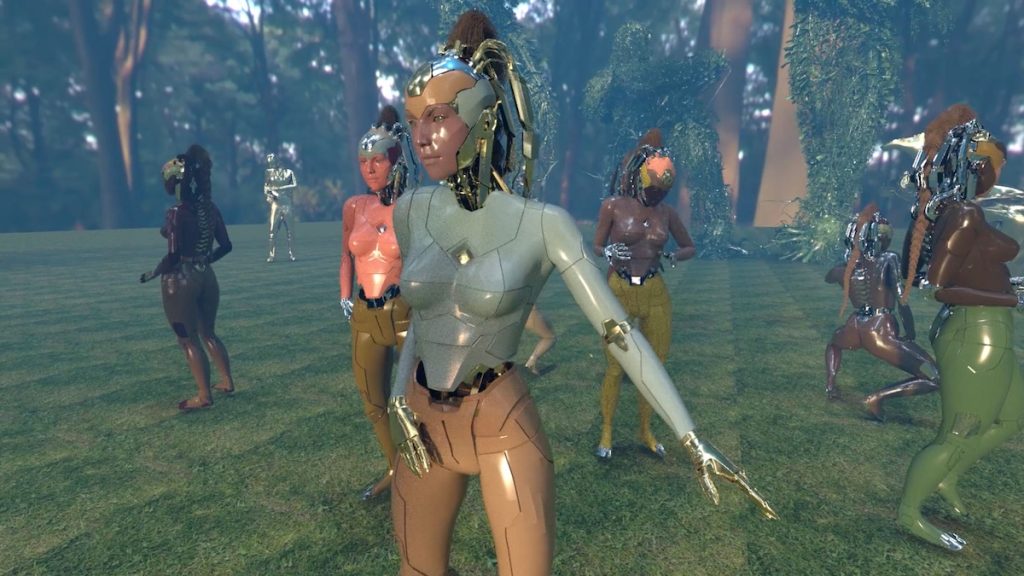
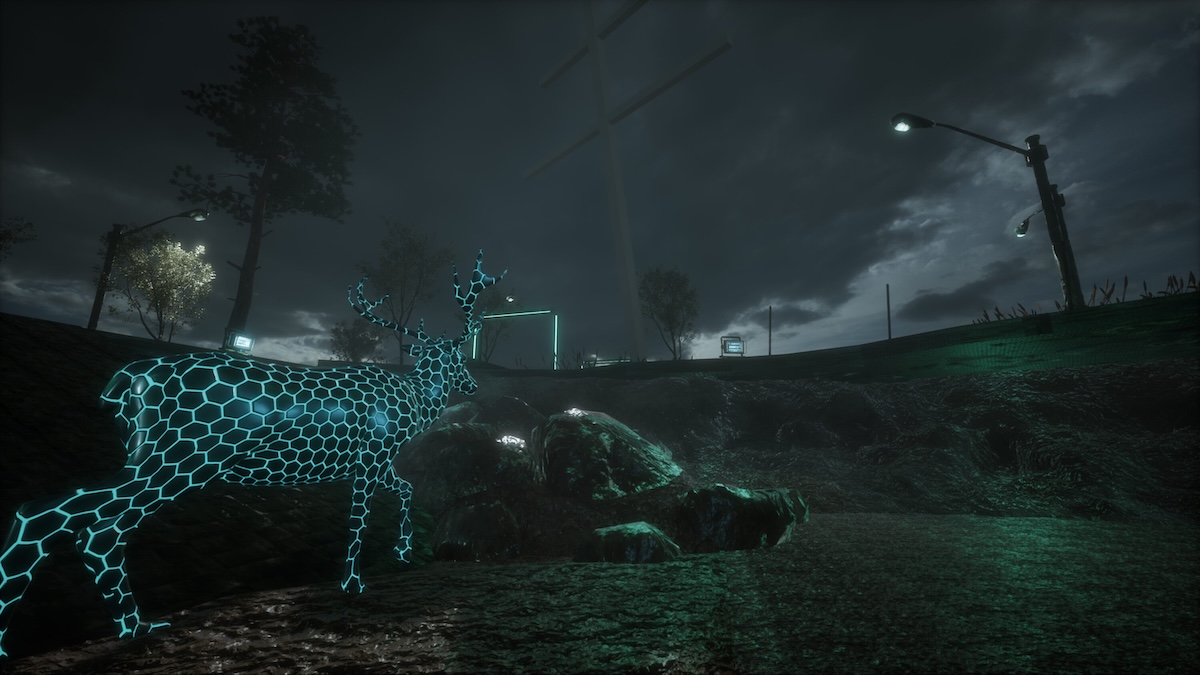
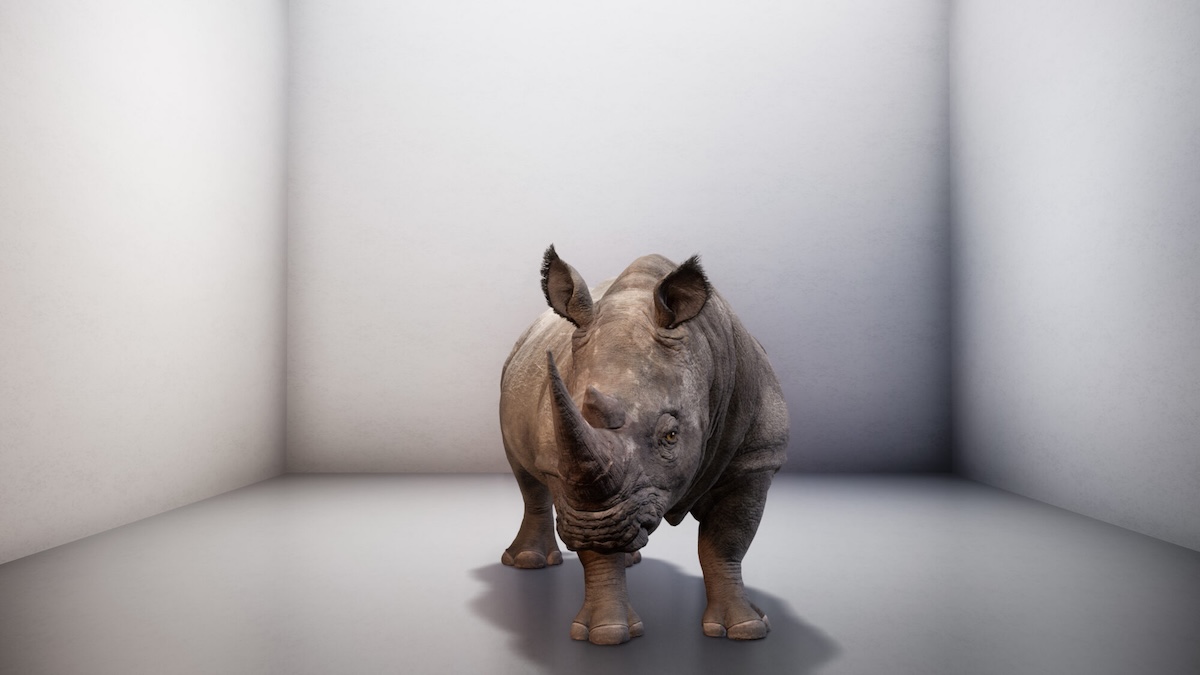
The exhibition is organized in three parts, moving from the biological toward the philosophical. “Endangered Species” opens with ecological and biological questions — Marguerite Humeau’s sculpture Kuroshio imagines a marine mammal that has become aware of its own mortality amid climate change, while Alexandra Daisy Ginsberg’s video installation The Substitute digitally recreates an extinct white rhino. “Dreams and Metamorphosis” shifts into psychological territory, borrowing surrealist strategies for a technological age; in Jacolby Satterwhite’s 3D animation We Are in Hell When We Hurt Each Other, female robots vogue across a landscape that refuses despair.
The final section, “Everything Is Connected,” turns toward ontology and Indigenous belief systems. Amelia Winger-Bearskin, a member of the Seneca–Cayuga Nation, uses artificial intelligence to strip modern human traces from footage of American landscapes in I Would Like to Be Midnight / I Would Like to Be Sky, directly using the technology associated with erasure to counter the legacy of settler colonialism instead. Saya Woolfalk’s Floating World of the Cloud Quilt closes the arc with an immersive, hypnotic installation imagining human-plant hybrids she calls Empathics.
Why Shimmer—Dreaming the Posthuman Closes a Chapter for Mark Scala
The exhibition is explicitly the final entry in a career-spanning series of thematic shows Scala has organized at the Frist, following Chaos and Awe: Painting in the 21st Century (2018), Phantom Bodies: The Human Aura in Art (2015), and Fairy Tales, Monsters, and the Genetic Imagination (2012), among others. Read against that arc, Shimmer reads less like a single exhibition than an argument Scala has been building for over a decade, and its closing note — that art’s role now is to help audiences feel their way into ecological and technological entanglement rather than simply observe it — may be less an ending than a hand-off to whichever institution or curator picks up the thread next.
A 166-page companion catalogue, Shimmer—Artists Dream a Posthuman World, published by MIT Press and co-edited by Scala and Nora N. Khan, extends the exhibition’s argument into criticism and theory. Shimmer—Dreaming the Posthuman remains on view at the Frist Art Museum through January 3, 2027, alongside a broader wave of institutional shows grappling with what technology means for how art gets made and felt.
You may also like
-
“No Other Place to Go”—5 Artists Turn Climate Data Into Human Experience at InLiquid Gallery
-
Erik Spehn Strips the Ground Away in “Waves Become Wings”
-
Zoya Cherkassky’s American Cooking Turns a Vintage Cookbook Into a Study of Displacement
-
“New Now IX” at InLiquid Gallery
-
Universal Nature—Rebecca Rutstein at the Berman Museum