
The question Marcus De Paula’s sculpture returns to most insistently is geological before it is aesthetic: what does it mean to make an object from material formed hundreds of millions of years ago, carve it into geometry, and make it glow?
His first major solo exhibition at Wexler Gallery in Philadelphia, opening June 11, constructs an answer across a body of work spanning 2019 to 2026 — ancient stone, integrated light, and the first indoor installation of a 3,000-pound granite structure built for open desert.
Marcus De Paula’s Sculptural Practice: Material as Argument
De Paula is a Brazilian-American sculptor born in California in 1986, now based in New York, whose practice operates at the intersection of geology, light, and cosmological imagination. The formal elements of his work — volcanic rock, Roman travertine, Spanish and Italian alabaster, Zimbabwean and Maine granite, black Nero Fossile marble — are chosen for their geological age as much as their physical properties.
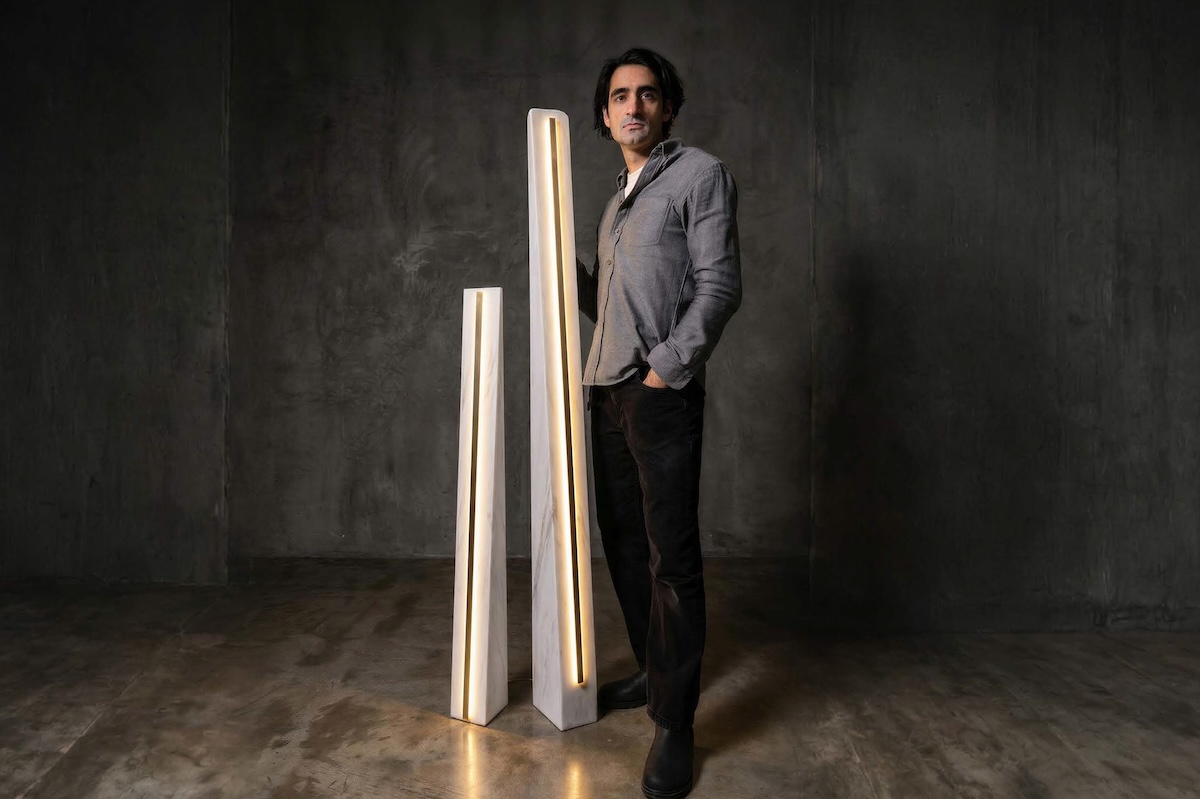
Stone formed during the Jurassic period, or 500 million years ago in the Precambrian, arrives in the studio already carrying a temporal argument. De Paula’s intervention is to carve these materials into reduced geometric forms and introduce light: LED, neon (triphosphor-coated glass filled with argon and mercury), gold leaf reflection, architectural bronze.
Each light source produces a different relationship to the stone — LED penetrates, neon suffuses, bronze reflects — and each introduces a different quality of presence.
De Paula’s biography is directly relevant to his formal concerns. His father, who rose from a small town in São Paulo to direct missions to Mars at NASA, filled the household with space imagery and the problem-solving logic of deep-space engineering. His mother is a painter and ceramicist.
These dual inheritances — cosmic scale and material sensitivity — converge in a sculptural practice that is simultaneously technically demanding and philosophically coherent. He also draws on more than fifteen years designing lighting for theater, film, and live performance, an experience base that shows in the precision with which illumination is integrated into each form.
Marcus De Paula and the Exhibition Structure of Interstice
The exhibition is organized around a spatial concept: the gallery as cosmic sculpture garden. Each work is positioned as a perceptual event within a constellation, requiring the viewer to move through the space and encounter objects that shift as they do.
The press materials draw alignment with James Turrell and Anish Kapoor — artists whose sculpture transforms into perceptual encounter — and the comparison holds. Like Turrell, De Paula uses light to make the viewer aware of the conditions of looking. Like Kapoor, he works with void and spatial distortion as sculptural content.
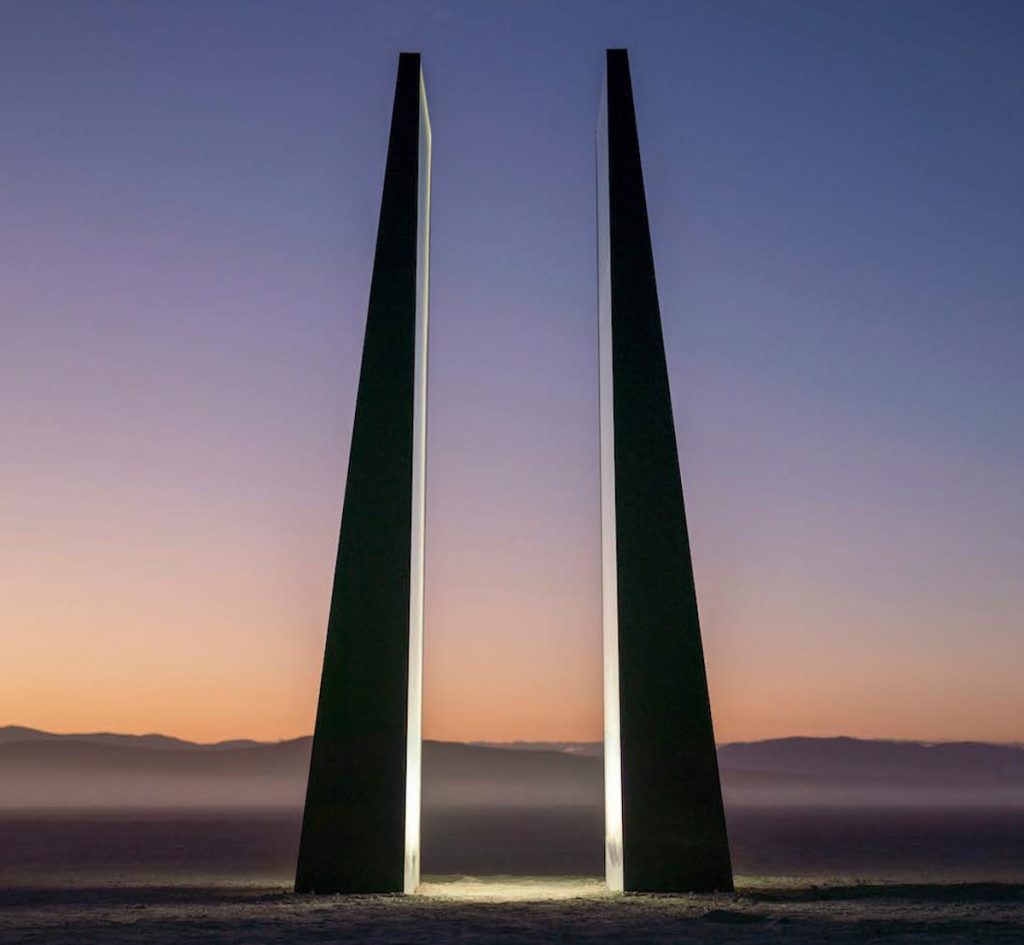
Anchoring the show is Titan (2022), a 10-foot-tall, 3,000-pound structure in Zimbabwean black granite making its first indoor presentation after debuting at Burning Man 2022. Two monumental granite pillars frame a narrow passage into a mirrored interior chamber; by day the polished surfaces reflect the surrounding environment, by night integrated light fills the interior with boundless luminosity.
Transporting Titan from the Black Rock Desert playa into a Fishtown gallery is not a neutral curatorial decision — it reframes a work built for open desert confrontation within an architectural enclosure, foregrounding the stone’s mass against finite walls in ways the original context could not.
New Works and Marcus De Paula’s Evolving Material Range
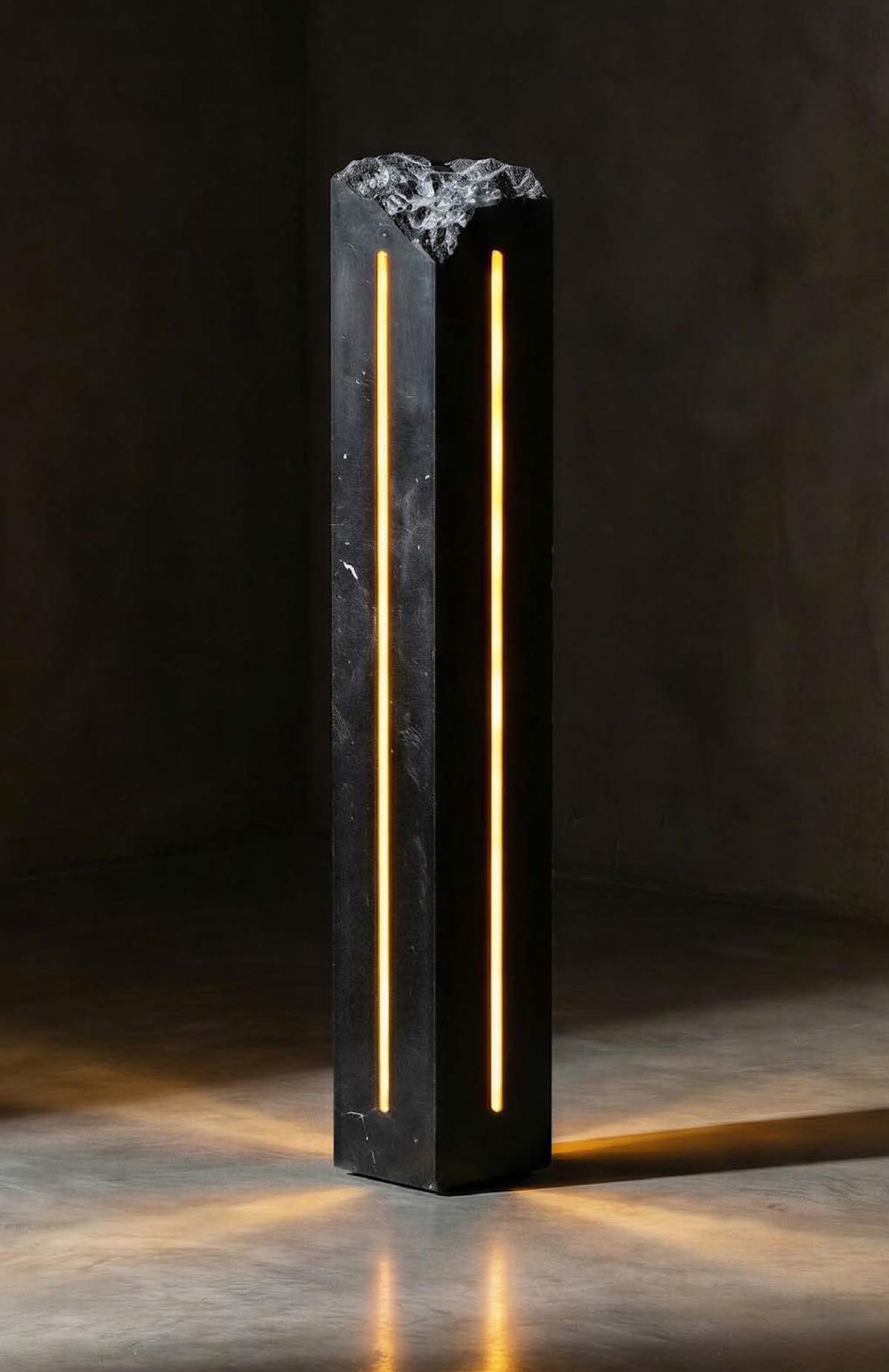
The 2026 works introduced in Interstice show a sculptor pushing at the limits of his material vocabulary. Theia (2026), in black Nero Fossile Italian marble with gold-leaf-lined channels and warm white LED, evokes molten energy rising through planetary crust. Asteria (2025), in fossil-bearing black marble with blue LED illumination, is carved from stone that carries the biological record of ancient life while being lit by a technological source entirely contemporary.
Coeus and Coeus Ultor (both 2026), in Carrara Statuario marble with architectural bronze, depart significantly from De Paula’s usual approach: the light source is concealed entirely, reflected indirectly from a brass accent to produce ambient glow rather than the penetrating vertical lines that characterize most of his work.
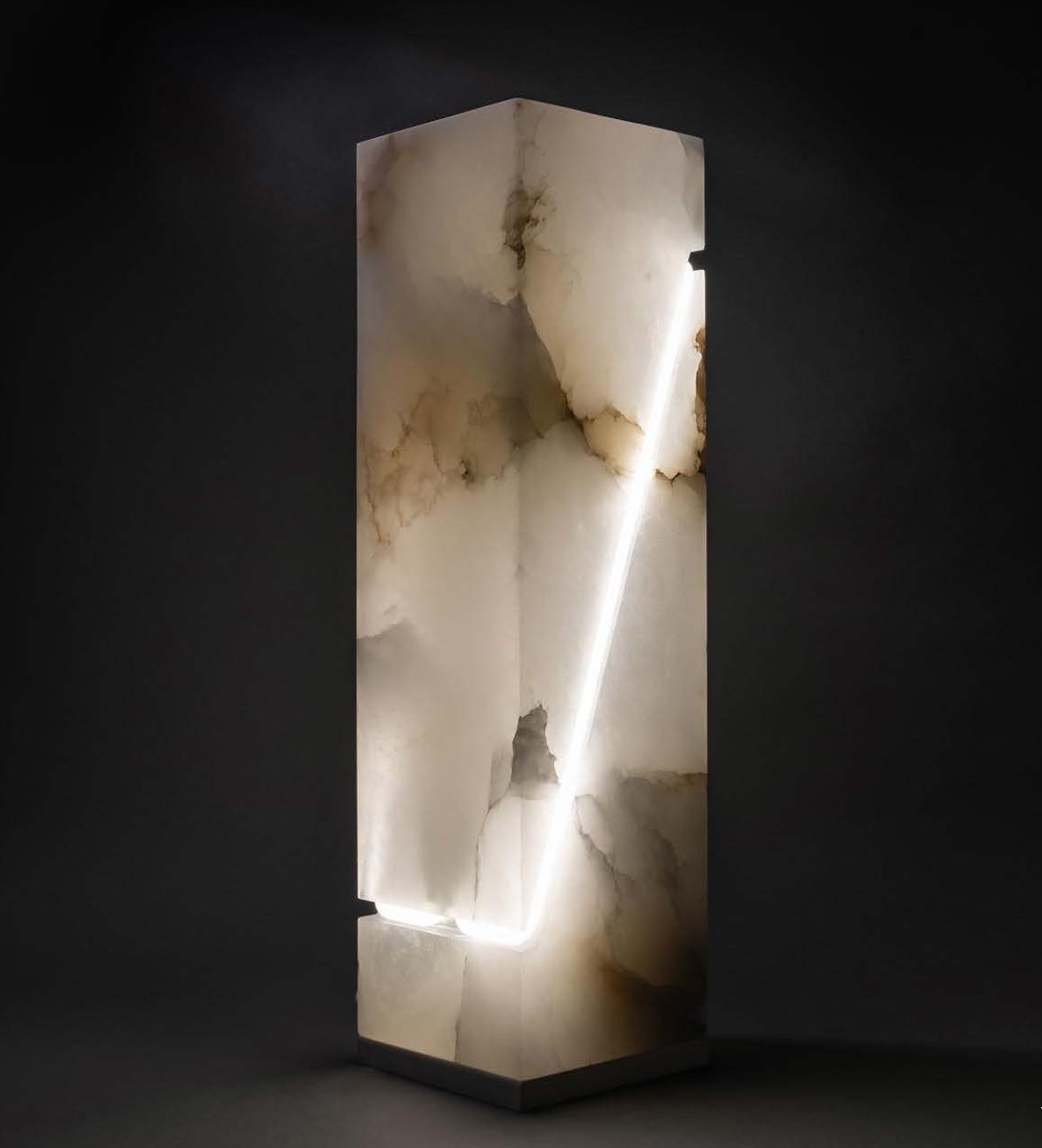
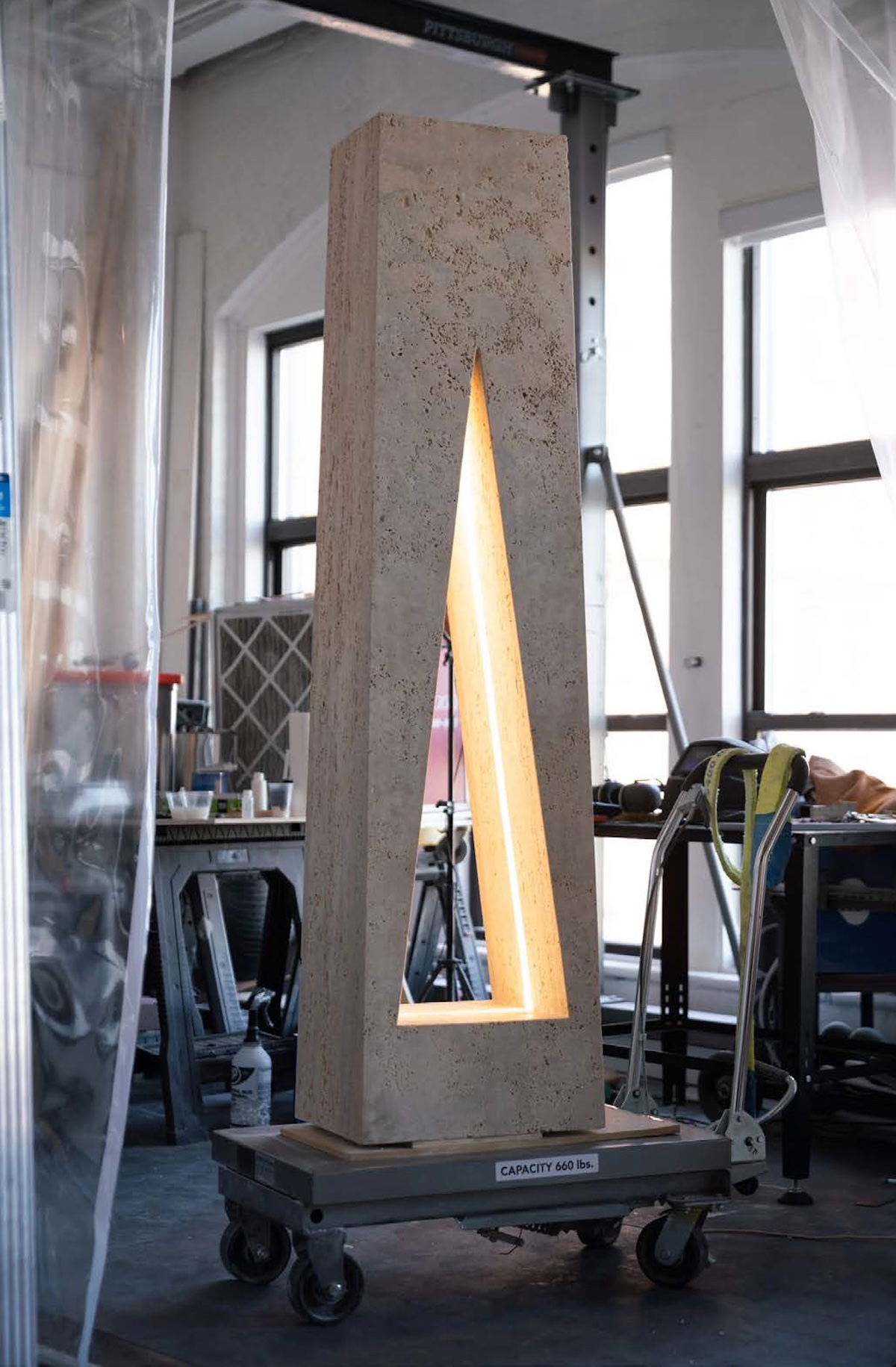
IO Prime (2025), a 72-inch column of Roman travertine with a central triangular void bisected by a warm plane of light, takes its name from Jupiter’s volcanically active moon and continues De Paula’s practice of naming works after celestial bodies to locate them within a cosmological rather than a human register. The Primordials Series, represented by Menoetius and Epimetheus (both 2023), works with 150-million-year-old Spanish alabaster blocks standing nearly 50 inches tall and weighing approximately 600 pounds each.
Marcus De Paula’s Parabola Series: Light as Subject Rather Than Source
The Parabola Series constitutes a conceptual pivot within the exhibition. These resin works — ranging from 12×12-inch editions to panels at 40×80 inches — do not emit light. They function as lenses, manipulating ambient light through reflection, refraction, and optical distortion. As the viewer moves, surfaces shift, dissolve, and reconfigure. The illusion is never fully explained and the mechanism never fully revealed. Where De Paula’s stone works operate through luminous penetration of ancient material, the Parabola Series turns that logic inside out: the work has no light of its own, only the light the viewer brings to it.
Together, these threads produce an exhibition about scale differentials: between the geological age of the materials and the brevity of the viewer’s presence, between the immensity of the cosmos De Paula invokes and the intimacy of a gallery on Frankford Avenue. De Paula articulates the project directly: “These sculptures are imagined as relics from another civilization, but in truth they are about our own. They ask what we leave behind, what survives us, and whether there is anything in our brief existence that might endure against the scale of geological and cosmic time.”
What Interstice ultimately argues is that the threshold of its title is not architectural but temporal — the gap between a visitor’s few minutes in the gallery and the hundreds of millions of years compressed into the stone they’re standing next to. The exhibition is on view at Wexler Gallery through August 14.
You may also like
-
Odds in the Absurd Puts Dada’s Oldest Question in Front of Six InLiquid Artists
-
Neil Anthony Edwards Traces Fashion From the 1910s to LeBron at Morton Contemporary
-
Made Over Time Puts Two Half-Century Painting Practices in One Room
-
“No Other Place to Go”—5 Artists Turn Climate Data Into Human Experience at InLiquid Gallery
-
Erik Spehn Strips the Ground Away in “Waves Become Wings”