
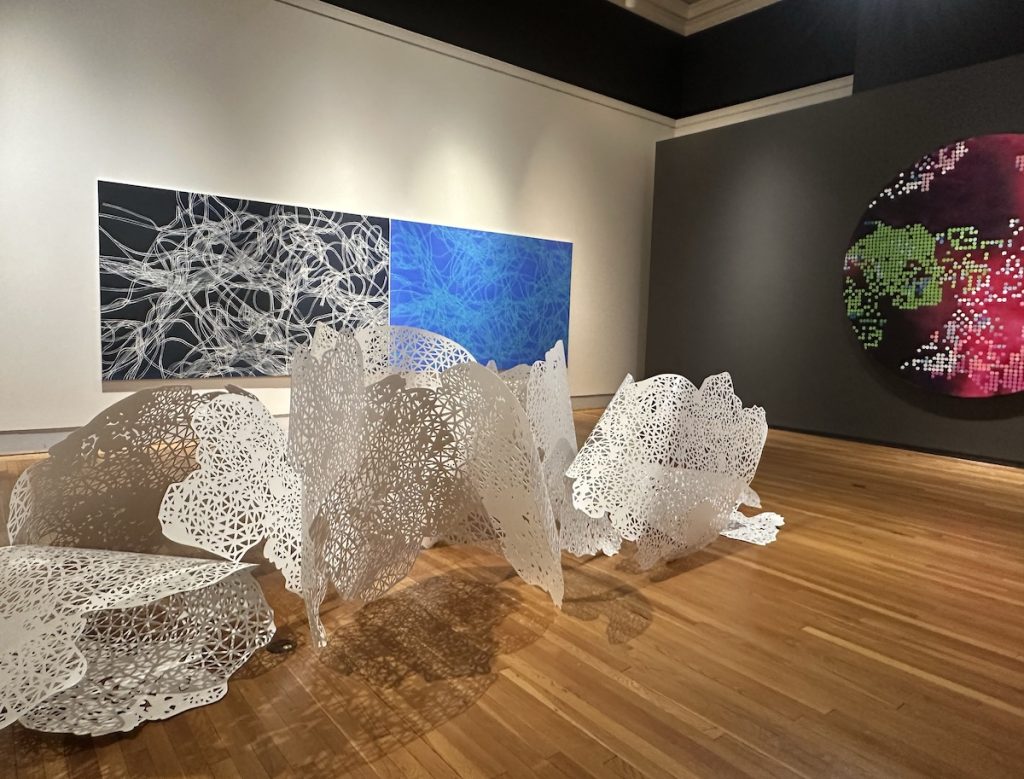
Rebecca Rutstein‘s Universal Nature opens at the Philip and Muriel Berman Museum of Art at Ursinus College as the most comprehensive solo exhibition the Philadelphia-based artist has received to date — a mid-career survey spanning large-scale paintings, suspended sculpture, video, textile, and new work developed during a 2026 expedition to Greenland. The exhibition runs June 16 through November 24, 2026, with a public reception on September 17.
Flow and the Hydrothermal Vent Research
Universal Nature is anchored at its center by Flow, a monumental suspended sculpture composed of hundreds of nickel-plated steel discs installed just above eye level in the Museum’s Main Gallery atrium. The discs respond to air currents — shifting, catching light, registering the movement of air as a kinetic field. The work draws from Rutstein’s ongoing scientific collaborations with researchers studying hydrothermal vents on the ocean floor, modeling the dispersal of trace elements including iron through ocean currents and their role in linking deep-sea ecosystems to the oxygen production that sustains surface life. The material is deliberate: nickel-plated steel participates in the same trace-element economy the sculpture visualizes. Flow is not illustrating the science; it is enacting it spatially.
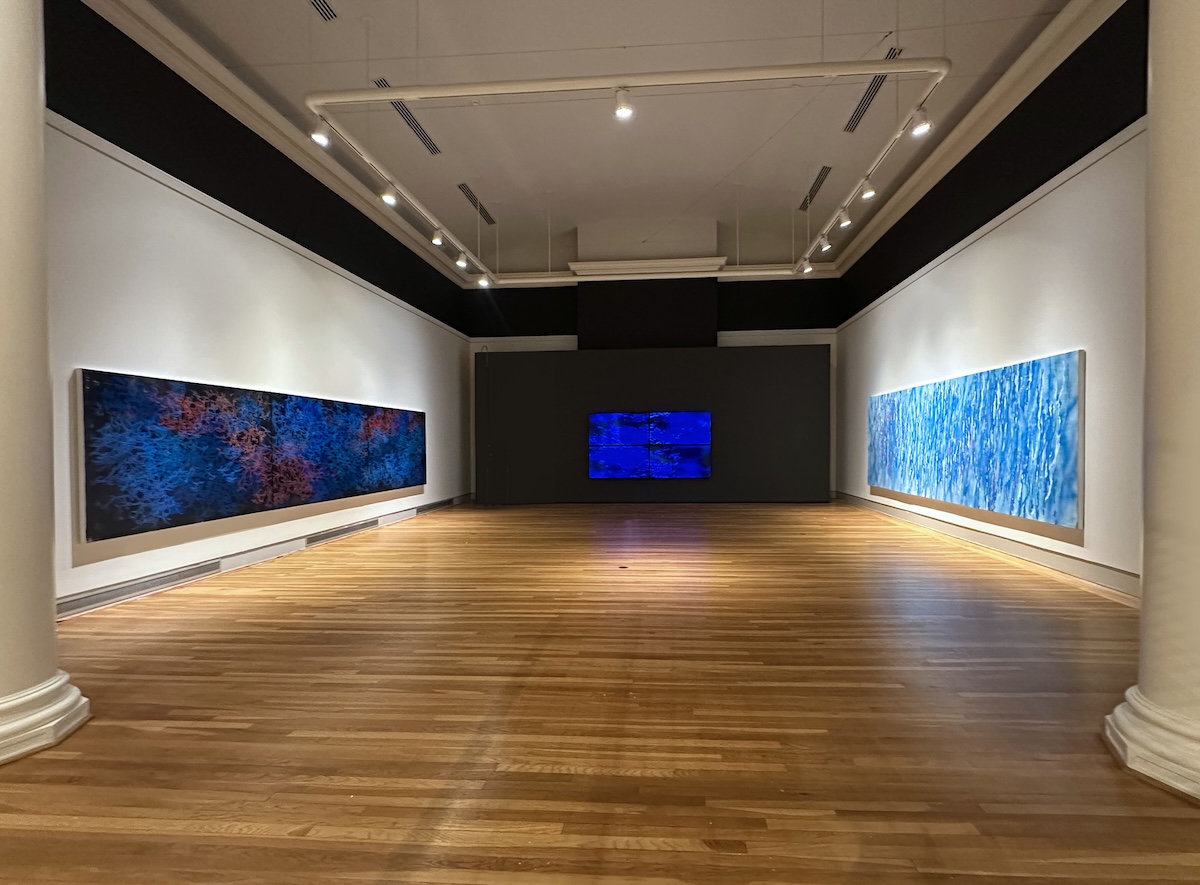
Rutstein’s Universal Nature survey reaches across the past decade and a half of her practice, including large-scale paintings Brine Forest and Shape Shifter, which operate at a scale that makes the systems she depicts — microbial, oceanographic, atmospheric — spatially immersive rather than illustrative. Rutstein’s method has been consistent: move between scientific fieldwork and studio practice, treating the research and the making as continuous rather than sequential.
The Greenland Expedition: Sea Ice Brine as Medium
The most recent body of work in Universal Nature was developed during a 2026 expedition to Greenland, undertaken in dialogue with microbiologist Jody Deming and collaborators from the Ocean Memory Project. The field methods — ice coring, microscopy, and direct collection — fed into the studio: Rutstein used sea ice brine as a painting medium, making work from the substance the paintings depict. The resulting work addresses the internal architecture of Arctic sea ice: its shifting, brine-filled channels and the microbial life they sustain at a moment when that architecture is measurably contracting.
Universal Nature’s Monograph and What the Survey Represents
The exhibition is accompanied by the first monograph dedicated to Rutstein’s practice — the first sustained scholarly documentation of a body of work built across fifteen years of scientific collaboration. The publication features a commissioned essay by Laura Turner Igoe, the Lenfest Chief Curator at the Michener Art Museum; an interview with Philadelphia gallerist Bridgette Mayer; and an introduction by National Magazine Award-winning journalist Susan Casey. The contributor combination — art historian, gallerist, journalist — reflects the cross-disciplinary reach of Rutstein’s practice itself.
Universal Nature is not a typical institutional survey, and the Berman Museum is not a typical venue for one, and the fact that this one is speaks to what Rutstein has accumulated over fifteen years of practice at the boundary of art and scientific fieldwork. The Greenland expedition, the vent research, the kinetic steel sculpture, and the first monograph arriving in the same institutional moment: the exhibition makes a considered case for the full frame of the work.
You may also like
-
“No Other Place to Go”—5 Artists Turn Climate Data Into Human Experience at InLiquid Gallery
-
Erik Spehn Strips the Ground Away in “Waves Become Wings”
-
Zoya Cherkassky’s American Cooking Turns a Vintage Cookbook Into a Study of Displacement
-
“Shimmer—Dreaming the Posthuman” Argues That Care, Not Extinction, Is the Point
-
“New Now IX” at InLiquid Gallery